Delivery from €16,90 per winemaker in Europe (excluding the United Kingdom)


AOC Alsace Pinot Noir
On the banks of the Rhine, the winemakers of the Alsace region treat us to their finest vintages. In this region, we find the AOC Alsace Pinot Noir. Originally from Burgundy, the grape variety of the same name is used in the production of red and rosé wines. It now accounts for around 10% of Alsace vineyards, but had almost disappeared at one time. AOC Alsace Pinot Noir wines have an ageing potential of up to 10 years. AOC Alsace wines account for 70% of the region's production, 90% of which is white.
Filtrer


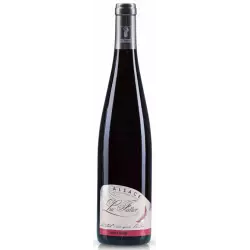

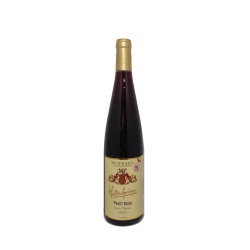


Alsace Pinot Noir: Rodern, Saint-Hippolyte, Ottrott
In wine country known above all for its whites, Pinot Noir is the main grape behind the reds and rosés of AOC Alsace, which Alsace estates bottle under the name Pinot Noir. Three village names can be added to the appellation, on a red only: Rodern and Saint-Hippolyte, in the Haut-Rhin, and Ottrott, in the Bas-Rhin.
History of AOC Alsace Pinot Noir
AOC Alsace Pinot Noir covers the entire Alsace vineyard, in a region famous for white wine. AOC stands for appellation d’origine contrôlée, France’s controlled designation of origin. AOC Alsace, recognized in 1962, sets the rules, and “Pinot Noir” is the name its reds and rosés carry when they are made from that grape alone.
Pinot Noir came to Alsace from Burgundy early on and was already grown there in the Middle Ages. After nearly vanishing, it made a comeback and now covers about 10% of the Alsace vineyard.
Climate and Terroir of AOC Alsace Pinot Noir
Climate: The Vosges mountains shield the vineyard from Atlantic weather, giving Alsace a semi-continental climate with cold winters and hot, dry summers. A foehn effect, strongest in the fall, adds to that shelter.
Colmar gets about 1,800 hours of sunshine a year, while the vineyard receives only 500 to 650 mm (20 to 26 inches) of rain. As the grapes ripen, warm days alternate with cool nights.
Soils: The sinking of the Rhine rift left a mosaic of small plots, mostly between 200 and 400 meters (650 to 1,300 feet) up. Soils range from schist, granite and sandstone on the Vosges side to limestone, marl and conglomerates in the foothills, with sandy, gravelly alluvium toward the plain. Each one gives its wines a character of their own.
Pinot Noir, Alsace’s Red Grape
An AOC Alsace wine labeled Pinot Noir is made from Pinot Noir alone, whether it is red or rosé. Among the Alsace appellations, only AOC Alsace makes still rosés: Alsace Grand Cru makes whites and, on three sites, Pinot Noir reds, and Crémant d’Alsace is sparkling. Pinot Noir is valued for its finesse and elegance.
Style of AOC Alsace Pinot Noir Wines
Color: The reds range from light ruby to deeper garnet. The rosés show a pink hue with salmon highlights.
Nose: Aromas lean toward fresh red fruit, such as cherry, strawberry and raspberry, sometimes with hints of spice and forest floor in older wines.
Palate: An AOC Alsace Pinot Noir shows finesse, light tannins and lively freshness.
Food Pairings with AOC Alsace Pinot Noir
A few classic pairings for a red or rosé AOC Alsace Pinot Noir from an Alsace estate:
Red: a charcuterie board, roast chicken, baeckeoffe (marinated meats and potatoes slow-baked in a sealed dish), stuffed quail.
Rosé: flammekueche (also called tarte flambée, a thin flatbread topped with cream, onions and bacon), tomato tart.
Village or Lieu-Dit: Stricter Rules for the Red
A red Pinot Noir that carries the name of a lieu-dit (a named vineyard site), or of Rodern, Saint-Hippolyte or Ottrott, follows stricter rules than a plain AOC Alsace red. At harvest, its grapes hold at least 185 grams of sugar per liter of must, versus 177, for a natural alcohol of 11.5% instead of 11%.
A rosé needs only 160 grams. On the Côte de Rouffach, which also makes whites, the reds follow the same rules.
In the vineyard, the average crop is capped at 9,000 kg of grapes per hectare (about 4 tons per acre), versus 11,500 kg for a plain AOC Alsace Pinot Noir. In the cellar, enrichment can add no more than 2% to the natural alcohol, and an enriched wine tops out at 14.5% in total, versus 14% for a plain red.
The appellation also describes two styles: ambitious, fine and elegant reds on one side, and fresh, fruity, light reds or rosés on the other.
Malolactic, Sugar, Yield: Alsace Pinot Noir in Practice
Does an Alsace Pinot Noir go through malolactic fermentation?
Every red AOC Alsace Pinot Noir completes malolactic fermentation and holds no more than 0.4 gram of malic acid per liter at bottling. This second fermentation turns sharper malic acid into softer lactic acid. The rule does not apply to rosés.
How much sugar can an Alsace Pinot Noir contain?
A red AOC Alsace Pinot Noir contains no more than 2 grams of sugar per liter, a rosé no more than 4, sometimes 5 depending on its acidity. A red AOC Alsace is therefore always a dry wine under EU labeling rules.
What is the maximum yield for a red Alsace Pinot Noir?
A red AOC Alsace Pinot Noir is capped at 60 hectoliters per hectare, about 640 US gallons per acre, versus 75 for a rosé. The cap stays at 60 with a lieu-dit or village name. Beyond that, an absolute ceiling applies: 66 hectoliters for reds, 90 for rosés.
Where can I buy AOC Alsace Pinot Noir wines direct from the winemaker?
You can buy AOC Alsace Pinot Noir wines direct from the winemaker on Avenue des Vins. Every wine’s page gives the name of its producer.
See also: Red wines from Alsace - Rosé wines from Alsace - AOC Alsace grand cru