Delivery from €16,90 per winemaker in Europe (excluding the United Kingdom)


AOC Alsace Riesling
The Riesling is a white grape fruity variety native of the Rhine Valley. Associated with the Alsatian vineyard and its mineral terroir, it gives dry and fresh white wines with a floral and delicate bouquet. Most Alsace wine, Riesling included, comes from the eastern foothills of the Vosges, at 650 to 1,300 feet (200 to 400 m), in one of France’s northernmost wine regions. Warm days and cool nights there help the Riesling grape keep its bright acidity.
Filtrer


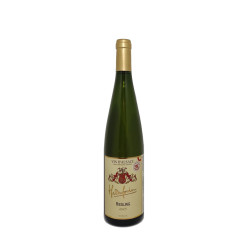


Alsace Riesling: From Dry to Late Harvest
History of the AOC Alsace Riesling
Riesling is, without a doubt, one of Alsace’s king grape varieties. With a history dating back several centuries, Alsace Riesling is often considered one of the best white wines in the world, enjoying an international reputation for its complexity and remarkable aging potential.
Climate and Terroir of the AOC Alsace Riesling
- Climate: Alsace benefits from a semi-continental climate with hot, sunny summers and cold winters. This combination, along with the region’s low rainfall, ensures slow and complete ripening of the grapes.
- Soils: The extraordinary mosaic of soils in the Alsace vineyard, alternating between limestone, granite, schist, and clay, provides the ideal environment for Riesling to express itself.
Riesling: The Signature Grape of AOC Alsace Riesling
Unsurprisingly, the signature grape of the AOC Alsace Riesling appellation is Riesling! This essential white grape variety in Alsace is one of the four noble grapes, alongside Pinot Gris, Gewurztraminer, and Muscat. Its adaptability to Alsace’s diverse terroirs allows AOC Alsace Riesling to showcase a beautiful diversity of aromatic and taste expressions.
Style of AOC Alsace Riesling Wines
Appearance: Pale yellow with green highlights.
Nose: Aromatic and elegant, Riesling reveals aromas of citrus, peach, white flowers (lime, orange blossom), and often a distinctive mineral hint of petrol as it ages.
Palate: Straightforward and racy, AOC Alsace Riesling dry white wines captivate with their vibrant acidity and purity. The finish is long and persistent, marked by a typical minerality.
Serving Temperature: 8°-10°
Aging Potential: 2 to 10 years
Best Food and Wine Pairings with AOC Alsace Riesling Wines
Follow our guide for the best food and wine pairings with a bottle of dry or sweet white wine from an AOC Alsace Riesling estate or château:
- Dry white: Sauerkraut with white wine, seafood platter, John Dory with orange butter, coq au Riesling
- Sweet white: Foie gras, maroilles, apricot tart
Dry or Sweet? How to Read an Alsace Riesling Label
With no further designation, an AOC Alsace Riesling is low in sugar: the appellation caps its residual sugar at 12 grams per liter. That cap does not apply to single-vineyard (lieu-dit) wines, wines with an added place name, or Vendanges Tardives and Sélection de Grains Nobles. To be sure, check the label: apart from late-harvest and Sélection de Grains Nobles wines, Alsace whites must state their sweetness in clearly visible type, from dry to sweet.
Vendanges Tardives (late harvest) and Sélection de Grains Nobles usually mean sweet wines, made from overripe grapes picked by hand, with no chaptalization. For Riesling, the juice needs at least 244 grams of sugar per liter for Vendanges Tardives and 276 grams for Sélection de Grains Nobles, sometimes thanks to noble rot. Both must carry a vintage and cannot be sold before June 1 of the second year after harvest.
A vineyard or village name after “Alsace” points to a wine from a smaller, delimited area within the appellation; Scherwiller and Wolxheim, for instance, are additional place names reserved for Riesling. Grand cru wines have their own appellation, AOC Alsace Grand Cru. As for aging, Alsace wines can improve in the bottle over time, and both late-harvest styles rank among wines built for very long cellaring.
Alsace Riesling FAQ
Is Alsace Riesling 100% Riesling?
Yes, an AOC Alsace Riesling is made exclusively from the Riesling grape; the appellation grants the name only on that condition. An Alsace white blended from several grapes can be labeled Edelzwicker.
What is the difference between “Alsace” and “Vin d’Alsace” on a label?
“Alsace” and “Vin d’Alsace” are the two official names of the same appellation, recognized as an AOC in 1962. A Riesling labeled either way follows exactly the same rules.
Why is Alsace Riesling bottled in Alsace?
Alsace Riesling is bottled in the Bas-Rhin or Haut-Rhin departments because a French law of July 5, 1972 requires it for all AOC Alsace wines. Growers wanted to protect the aromas of their wines, which suffered when shipped in bulk over long distances.
Why does Alsace Riesling come in a tall flute bottle?
Alsace Riesling comes in a tall, slender flute, known as the “Rhine wine” bottle, because it is the traditional bottle for still Alsace wines. A 1959 decree reserves it for a few appellations, Alsace among them, and AOC Alsace requires this bottle or a very similar shape.
Where can you buy Alsace Riesling direct from the winemaker?
You can buy Alsace Riesling direct from the winemaker on Avenue des Vins. Each order is prepared and sent by the producer, not from a warehouse.
See also: AOC Alsace Pinot Gris - AOC Alsace Gewurztraminer - AOC Alsace Sylvaner