Delivery from €16,90 per winemaker in Europe (excluding the United Kingdom)

Château Le Pin Beausoleil
Château Le Pin Beausoleil: organic Bordeaux Supérieur direct from the estate, facing Saint-Émilion...
Lire plus



Discover Château Le Pin Beausoleil in photos


Château Le Pin Beausoleil, organic Bordeaux Supérieur facing Saint-Émilion
Château Le Pin Beausoleil - AOC Bordeaux Supérieur (Saint-Vincent-de-Pertignas, Gironde)
Château Le Pin Beausoleil is an 8.5-hectare estate in the Bordeaux Supérieur appellation, based in Saint-Vincent-de-Pertignas, Gironde, on a plateau rising to 86 metres opposite Saint-Émilion. Michael and Ingrid Hallek make two red wines and one rosé there, all certified organic, from merlot, cabernet franc and cabernet sauvignon.
You reach Le Pin Beausoleil along a narrow road through the Entre-deux-Mers, and the view opens up all at once: 86 metres above the vines, a pale stone building with its tower, orchards, and the outline of Saint-Émilion on the horizon. Michael and Ingrid Hallek took the place on in 2004 and rushed nothing: replanting, an organic conversion carried through to certification, hand harvesting, patient ageing. Three wines come out of it, regularly singled out by the Guide Hachette and the international press, available directly from the grower on Avenue des Vins.
Nine centuries of history, twenty years of vines
Long before it was a wine estate, Le Pin Beausoleil was a stronghold. The fortress was built in the 9th century on one of the highest plateaus in the Gironde, with four towers, portcullises and a drawbridge — a lookout point commanding the whole valley. It then passed from one noble family to the next without losing its bearing. Gironde archives record one such owner, Bernard Angevin, lord of Rauzan and Pujols, who bought the noble house of Le Pin in 1447.
Vines only became the main business again in 1997, when the manor was restored and the property took the name it carries today. The first vintage was released in 1998, made with the consulting oenologist Stéphane Derenoncourt. The estate quietly built a reputation among characterful Bordeaux Supérieurs: a Guide Hachette coup de coeur as early as the 2001 edition, another for the 2002 vintage.
Michael and Ingrid Hallek discovered the property in 2003 and bought it the following year. Michael Hallek did not inherit a Bordeaux vineyard: a professor of medicine and a haematologist in Cologne, he came to Le Pin with the patience of someone whose profession consists of observing at length before drawing conclusions. The couple undertook major works, replanted and reorganised the vineyard. The estate company is called MIVIDA, after the first letters of Michael, Ingrid, Vivian and David, their two children — and it also reads as « mi vida », my life in Spanish.
The team was built to last. Igor joined in 2013 as technical director and runs the vineyard and the organic farming. André works in the vines and in the cellar, and Émilie handles sales and welcomes visitors to the château. After more than twenty-five vintages alongside the property, Stéphane Derenoncourt handed over: since 2024 the blending has been guided by Thomas Duclos, a consulting oenologist who also advises leading Saint-Émilion estates. And there is Alaska, the white Swiss shepherd dog, who decided once and for all that guarding the vines was part of her duties.
|
||
|
||
|
||
|
||
|
A plateau at 86 metres, opposite Saint-Émilion
The vineyard sits on one of the highest points in the Gironde. At 86 metres, the plateau looks down over the surrounding valleys and across to the medieval village of Saint-Émilion. That elevation is no small detail in a famously flat part of Bordeaux: it keeps the plots ventilated, limits the stagnant humidity that encourages disease, and slows ripening slightly. In increasingly hot summers, that delay has become an asset — the grapes hold on to freshness and acidity where others simply bake.
The soils combine clay, limestone and gravel, with depths that change from plot to plot. Clay holds water and gives merlot its flesh; limestone brings tension and that upright finish; gravel drains and warms, which suits the cabernets. The 8.5 hectares are spread over three villages: 5.5 hectares at Saint-Vincent-de-Pertignas around the château, one hectare at Rauzan and two at Mérignas. The vineyard is planted at 6,500 vines per hectare, a density that forces each vine to dig deep rather than to crop heavily.
AOC Bordeaux Supérieur - Saint-Vincent-de-Pertignas (Gironde)
Clay, limestone and gravel - 8.5 hectares of certified organic vines
Bordeaux Supérieur is not simply a flattering label: the appellation requires lower yields than plain AOC Bordeaux, a higher minimum alcohol level and at least nine months of ageing before release. It is the appellation of small-volume Bordeaux made to be kept. At Le Pin Beausoleil it applies to plateau plots farmed organically, picked by hand and vinified plot by plot before blending.
Organic farming as a working method, not a selling point
The decision was taken in 2014: no more synthetic pesticides, herbicides or fertilisers, and organic farming across the whole vineyard. The conversion took the time it needed. The 2021 vintage was the first to be fully certified, audited by EuroCert; the labels now carry the French AB logo and the European organic leaf. Between the rows, cover crops, grassing and compost have replaced chemistry, and winter pruning is done by hand, vine by vine.
Around the vines the estate has kept what makes a farm alive: orchards, hedges and fruit trees. These are not decoration. Hedges shelter the birds that keep insect populations in check, trees and flowers feed pollinators, and the butterflies and bees that have come back to the property are the clearest sign that the soils are recovering. A vineyard surrounded by living things defends itself far better than one stranded in a green desert.
Hand harvesting, concrete vats and barrels
Harvesting is done by hand, variety by variety, each plot picked when it is ready: the merlot destined for the rosé first, in early September, then the red merlots, and the cabernets last, often a good week later. Picking by hand means sorting with the secateurs and bringing whole, undamaged berries into the cellar.
Fermentation takes place in temperature-controlled concrete vats, a neutral material that adds no flavour of its own and keeps temperatures steady. Macerations are long, around four weeks, with gentle extraction: the aim is depth rather than power. Malolactic fermentation then takes place in barrel, and the wine is aged for twelve to eighteen months depending on the vintage, half in new oak and half in one-year-old barrels, in 225 and 400 litre casks from three Bordeaux coopers chosen for the delicacy of their toasting.
Blending is the decisive moment of the year. It happens in January, lot by lot, between Igor and Thomas Duclos: deciding how much merlot will provide the flesh, how much cabernet franc the perfume and the line, how much cabernet sauvignon the structure. The proportions shift markedly from one year to the next, from 50 % to 80 % merlot. That is why two vintages of the same wine never taste quite alike.
The wines of Château Le Pin Beausoleil
Three wines, all certified organic and made in small quantities: the château's grand vin, its more immediate second wine, and a summer rosé. Here is how to tell them apart and when to serve them.
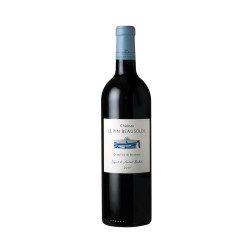
Château Le Pin Beausoleil
AOC Bordeaux Supérieur red - merlot, cabernet franc, cabernet sauvignon - barrel-aged
The estate's grand vin, made in around 10,000 bottles per vintage. Elegant and structured, it holds the balance between ripe fruit, generous texture and restrained oak. Cabernet franc gives it its red-fruit and violet perfume, cabernet sauvignon its backbone. Serve with roast meats, duck breast, rack of lamb or a board of mature cheeses. Keeps five to twenty years depending on the vintage.
Petit Soleil
AOC Bordeaux Supérieur red - merlot-led - aged in vat, no oak
The château's second wine, from the younger plots and aged in vat to keep the fruit clean and direct. Supple and approachable, with a fresh, fruity, thoroughly enjoyable palate and none of the grand vin's tannic frame. This is the estate's weeknight Bordeaux: grilled meats, charcuterie, slow-cooked dishes, stuffed tomatoes. Drink within five to ten years.
Petit Soleil Rosé
Bordeaux rosé - 100 % merlot - direct pressing
A Bordeaux-style rosé, made by pressing merlot directly under a protective atmosphere to keep the aromatics intact, then fermented in concrete and bottled early. Bright colour, vinous aromas, a crisp palate and refreshing acidity. It does far more than aperitif duty: it stands up to a charcuterie board, a tomato salad, grilled fish or spiced cooking. Drink within the year, at around 10 °C.
Worth knowing: total production remains modest, around 10,000 bottles of the grand vin and a few thousand of Petit Soleil. The wines come in 75 cl bottles and, in some vintages, in magnum, a format that ages more slowly and never fails to make an impression at the table. Available vintages depend on what remains in the estate's cellar.
What the critics say
France's Guide Hachette des Vins has followed the property for twenty-five years: coups de coeur for the 1998, 2002 and 2010 vintages, two stars for 2016, 2020 and 2021, and two stars for Petit Soleil 2021 as well. The international press points the same way: the 2022 scored 93/100 from Antonio Galloni (Vinous) and 92-93 from James Suckling, the 2020 earned 94/100 at Vinous, the 2019 was rated 92/100 by both Decanter and Vinous, and the 2021, the first certified organic vintage, took 91/100 at Falstaff. Earlier, the 2009 won a silver medal at the Decanter World Wine Awards.
Antonio Galloni, Vinous, on the 2020 vintage: « simply excellent ».
Bought directly from the estate, with no extra middleman - Delivery across France and Europe
Why choose the wines of Château Le Pin Beausoleil
A genuinely certified organic Bordeaux. Not a vague claim of sustainability: the entire vineyard is farmed organically and audited by a certification body, from the 2021 vintage onwards, after a conversion begun seven years earlier.
Altitude, which is rare in Bordeaux. At 86 metres on one of the highest plateaus in the Gironde, the plots are well ventilated and ripen a little later, which preserves freshness in hot vintages.
Consistency the critics have noticed. Coups de coeur and stars in the Guide Hachette since the 2001 edition, and scores between 91 and 94/100 from Vinous, James Suckling, Decanter and Falstaff on recent vintages.
Genuinely small volumes. Around 10,000 bottles of grand vin a year from 8.5 hectares: a long way from supermarket Bordeaux, with plots vinified separately and blended by hand.
Direct from the grower. You order from the estate itself, with no additional middleman: the bottles leave the property where they have been stored, and are delivered in France and across Europe.
Frequently asked questions about Château Le Pin Beausoleil
Where is Château Le Pin Beausoleil located?
Château Le Pin Beausoleil is located in Saint-Vincent-de-Pertignas, Gironde (33420), in the Entre-deux-Mers, about fifteen kilometres from Saint-Émilion. The estate occupies a plateau rising to 86 metres, one of the highest points in the department, with a view across to the medieval village of Saint-Émilion. The vineyard also extends into the neighbouring villages of Rauzan and Mérignas.
Who are the winegrowers at Château Le Pin Beausoleil?
The estate has belonged to Michael and Ingrid Hallek since 2004. Michael Hallek is a professor of medicine and a haematologist in Cologne; the couple discovered the property in 2003 and restored it completely. On site, Igor has run the vineyard and the organic farming since 2013, André works in the vines and in the cellar, and Émilie handles sales and visitor welcome. Blending is guided by consulting oenologist Thomas Duclos.
Are the wines of Château Le Pin Beausoleil organic?
Yes. The whole vineyard is certified organic, the 2021 being the first fully certified vintage after a conversion begun in 2014. Certification is carried out by EuroCert and the labels bear the French AB logo and the European organic leaf. In practice this means no synthetic pesticides, herbicides or fertilisers, mechanical soil work and cover crops between the rows.
What appellation are the wines of Château Le Pin Beausoleil?
Both red wines are AOC Bordeaux Supérieur; the rosé is a Bordeaux rosé. The Bordeaux Supérieur appellation applies stricter rules than plain AOC Bordeaux: limited yields, a higher minimum alcohol level and at least nine months of ageing before release. It is the appellation of small-volume Bordeaux made to be kept.
Which grape varieties are used at Château Le Pin Beausoleil?
The vineyard is planted mainly to merlot, complemented by cabernet franc and a small share of cabernet sauvignon. Merlot, round and generous, brings ripe fruit aromas and suppleness; cabernet franc, earlier-ripening and slender, brings finesse, acidity and notes of red fruit and violet; cabernet sauvignon brings tannic richness and ageing potential. The proportions change with every vintage, from 50 % to 80 % merlot depending on the year.
What is the difference between Château Le Pin Beausoleil and Petit Soleil?
Château Le Pin Beausoleil is the grand vin, aged twelve to eighteen months in barrel and drawn from the best plots; Petit Soleil is the second wine, aged in vat with no oak and made from younger vines. The first is structured and built to wait, the second is supple, fruity and ready to drink. There is also a Petit Soleil Rosé, made from directly pressed merlot.
What does MIVIDA, the name of the estate company, mean?
MIVIDA brings together the first letters of the family's names: Michael, Ingrid, Vivian and David. The word also reads as « mi vida », my life in Spanish. It is the name of the company that farms Château Le Pin Beausoleil, and it sums up rather well what the estate means to its owners.
Has Château Le Pin Beausoleil won any awards?
Yes, regularly. France's Guide Hachette des Vins awarded coups de coeur to the 1998, 2002 and 2010 vintages, and two stars to the 2016, 2020 and 2021 vintages as well as to Petit Soleil 2021. Internationally, the 2022 scored 93/100 from Antonio Galloni (Vinous), the 2020 earned 94/100 at Vinous, the 2019 was rated 92/100 by Decanter, and the 2009 won a silver medal at the Decanter World Wine Awards.
How long can you keep a Château Le Pin Beausoleil?
The grand vin keeps for five to twenty years depending on the vintage, and Petit Soleil for five to ten years. A Bordeaux Supérieur of this kind usually opens up well after three to five years in bottle, once the oak has melted into the fruit. Store the bottles lying down, away from light, between 12 and 14 °C, somewhere without sudden temperature swings: stability matters more than the exact temperature.
At what temperature should the wines be served, and should they be decanted?
Serve the reds at around 16 °C, slightly cooler than room temperature, and the rosé at around 10 °C. With a young vintage of the grand vin, an hour in a decanter before serving helps the aromas open. With an older vintage, it is better to open the bottle without decanting and let the wine unfold in the glass.
What food goes with a Bordeaux Supérieur from Le Pin Beausoleil?
The grand vin goes with roast and grilled meats: rib of beef, duck breast, rack of lamb with herbs, but also game birds or firm mature cheeses. Petit Soleil, being suppler, works with barbecue, charcuterie, an entrecôte bordelaise or an everyday casserole. The rosé holds its own with tomatoes, grilled fish and spiced cooking.
How should Petit Soleil Rosé be served?
Petit Soleil Rosé is a Bordeaux-style rosé, 100 % merlot, to be drunk young, within the year following bottling, at around 10 °C. The colour is bright and the palate crisp, with refreshing acidity. It goes well beyond aperitif duty: serve it with a charcuterie board, a tomato salad, grilled fish or spiced cooking.
Is Château Le Pin Beausoleil a good wine to give as a gift?
It is a gift that manages to be both safe and uncommon. Safe, because the estate has been singled out by the Guide Hachette for twenty-five years and rated between 91 and 94/100 by the international press. Uncommon, because at around 10,000 bottles a vintage this is not a wine you meet everywhere. A vintage that has already opened up, roughly five to eight years old, or a magnum for an anniversary, are two safe bets.
Can you visit Château Le Pin Beausoleil?
Yes, the estate welcomes visitors for château tours and tastings, by appointment. Émilie looks after visitor welcome and wine tourism. The property is at 774 route de Bonhoste au Pin, Saint-Vincent-de-Pertignas (33420), and can be reached on +33 5 57 84 02 56. It is best to arrange a time in advance: this is a family estate, not a drop-in attraction.
Where can you buy Château Le Pin Beausoleil wines directly from the estate?
Château Le Pin Beausoleil wines are available on Avenue des Vins, directly from the estate, with no additional middleman. The bottles are kept at the property until dispatch and travel in packaging designed for wine. Delivery is available in France and in eligible European countries, and the vintages on offer depend on what is still in stock at the château.
Certified organic wines, shipped from the estate in Saint-Vincent-de-Pertignas
Château Le Pin Beausoleil, AOC Bordeaux Supérieur in Saint-Vincent-de-Pertignas (Gironde), 8.5 hectares of certified organic vines, run by Michael and Ingrid Hallek.
Merlot, cabernet franc and cabernet sauvignon - Château Le Pin Beausoleil, Petit Soleil and Petit Soleil Rosé