Delivery from €16,90 per winemaker in Europe (excluding the United Kingdom)


AOC Alsace Sylvaner
On the banks of the Rhine, the winegrowers of the Alsace region delight us with their best vintages. In this region, we find in particular the AOC Alsace Sylvaner. Sylvaner is a rather late white grape variety, which produces relatively light, lively and fruity wines. It is native to Austria and has been planted in Alsace since the 18th century. Present in France only in Alsace, it represents approximately 12% of this 15,000-hectare vineyard. The wines of the AOC Alsace represent 70% of the regional production and are 90% white wines.
Filtrer


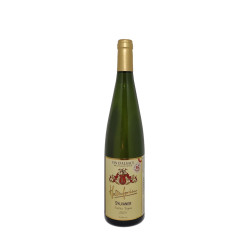

Alsace Sylvaner: Blienschwiller and Côtes de Barr
Two of the geographic names of AOC Alsace belong to Sylvaner alone, one for Blienschwiller, the other for Côtes de Barr. On the bottle, either name comes after “Alsace” for a white wine from delimited vineyards in the village of Blienschwiller or of Barr, in the Bas-Rhin.
Riper, Lower-Yielding: Sylvaner with a Village Name
An Alsace Sylvaner that shows only the appellation can be picked once the must holds 151 grams of sugar per liter, and its yield can reach 100 hectoliters per hectare (about 1,070 US gallons per acre).
Under the Blienschwiller or Côtes de Barr name, the grapes must reach 168 grams, for at least 10.5% natural alcohol. Yields drop to 72 hectoliters per hectare, and the crop load allowed on each plot falls from 14,000 to 12,000 kg per hectare (about 6.2 to 5.4 tons per acre).
In these two villages, as everywhere else in Alsace, Sylvaner stays outside the Vendanges Tardives and Sélection de Grains Nobles designations, which the appellation reserves for other grapes.
History of the AOC Alsace Sylvaner appellation
The AOC Alsace Sylvaner is an appellation highly appreciated for its subtlety, freshness and its ability to reveal the Alsatian terroir. Originally from Austria, the Sylvaner grape variety appeared in Alsace in the 18th century and quickly became an essential white grape variety in the region. The AOC Alsace Sylvaner is today appreciated for its fresh and light white wines, offering a fruity aromatic palette and a pleasant liveliness.
Climate and terroir of the AOC Alsace Sylvaner appellation
- Climate: Alsace benefits from a semi-continental climate, offering hot and dry summers, and low rainfall conducive to optimal ripening of the grapes.
- Soils: With a remarkable geological diversity (granite, limestone, gneiss, etc.), the soils of Alsace give white wines made from Sylvaner a remarkable finesse and aromatic diversity.
Sylvaner: emblematic grape variety of the AOC Alsace Sylvaner
Sylvaner is a very popular white grape variety in Central Europe and Germany. Introduced in Alsace in the 18th century, Sylvaner is a rather late grape variety that offers high yields even in northern areas. Although it was long planted on the plains, producing thirst-quenching white wines, when planted on hillsides and on the best terroirs of Alsace it produces more intense wines.
Style of AOC Alsace Sylvaner wine
Appearance: Light color, often pale yellow with green highlights.
Nose: The bouquet presents aromas of white flowers, green apple, lemon, with sometimes vegetal notes.
Palate: The wines are lively, light, with a nice acidity and a clean, thirst-quenching and mineral finish.
Serving temperature: 8°-10°
Aging potential: 1 to 3 years. The majority of AOC Alsace Sylvaner wines are appreciated in their youth for their freshness, although they can gain in complexity with a few years in the cellar depending on the estate and the vintage.
The best food and wine pairings with an AOC Alsace Sylvaner white wine
Here are some tips and recipe ideas to accompany a bottle of dry white wine from an AOC Alsace Sylvaner estate or château:
- Oysters and other shellfish
- Asparagus
- Seafood sauerkraut
- Onion tart
- Frog legs with parsley
Going Further with Alsace Sylvaner
Which Alsace grand cru allows Sylvaner?
The Zotzenberg, in Mittelbergheim, is the only one of Alsace’s 51 grands crus where Sylvaner is allowed. Recognized in 1992, this slope faces south and southeast and sits on very dense marl over limestone bedrock. Grapes there must reach 170 grams of sugar per liter of must.
Can an Alsace Sylvaner be labeled with a lieu-dit?
An Alsace Sylvaner with a lieu-dit must, among other requirements, stay within 68 hectoliters per hectare, the lowest cap AOC Alsace sets for this grape. On the label, the lieu-dit follows the appellation name and comes before the word Sylvaner.
When can a young Sylvaner vine produce AOC Alsace wine?
A young Sylvaner vine planted before July 31 qualifies for AOC Alsace from the second year after planting. For a lieu-dit wine, or one labeled Blienschwiller or Côtes de Barr, the wait runs to the third year.
Where can I buy Alsace Sylvaner direct from the winemaker?
You can buy Alsace Sylvaner direct from the producer on Avenue des Vins. Every wine’s page lists its grape varieties.
See also: AOC Alsace Pinot Blanc - AOC Alsace grand cru - AOC Alsace Muscat