Delivery from €16,90 per winemaker in Europe (excluding the United Kingdom)


AOC Alsace grand cru
Alsace Grand Cru wines come from Alsace, the wine region that runs along the Rhine in northeastern France. There, Alsace winegrowers make their grand cru wines under a very strict set of production rules. They come from vineyard plots selected across the region for their exposure to the sun. The growing area for Alsace Grand Cru lies within 46 communes of the Alsace vineyard.
Filtrer


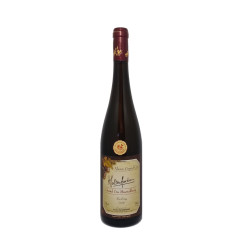


Alsace Grand Cru: Four Decrees, from 1975 to 2007
Alsace’s grand cru sites were classified over 32 years. The decree of November 20, 1975, named just one site, the Schlossberg. Two more decrees, in 1983 and 1992, added 25 and then 24 sites. The fourth, in January 2007, recognized the Kaefferkopf, though a court had marked out its boundaries back in 1932, a first in Alsace.
History of the AOC Alsace Grand Cru Appellation
The AOC Alsace Grand Cru is the jewel of the Alsace vineyard. Established in 1975, this appellation encompasses the region’s exceptional terroirs, steeped in an ancient winemaking tradition. These parcels, selected from over fifty distinct locations, stand out from other terroirs due to their unique characteristics. As a result, AOC Alsace Grand Cru wines are the product of a skill passed down through generations, guaranteeing white wines of the highest quality.
Climate and Terroir of the AOC Alsace Grand Cru Appellation
Climate: Benefiting from a semi-continental climate, Alsace is shielded from oceanic influences by the Vosges Mountains, resulting in low rainfall and hot, dry summers.
Soils: The diversity of soils (granite, schist, limestone, sandstone) gives the wines of AOC Alsace Grand Cru a distinctive complexity and rich aromatic profile.
The Iconic Grapes of AOC Alsace Grand Cru
The main grapes permitted within the AOC Alsace Grand Cru appellation are Riesling, Gewurztraminer, Pinot Gris, and Muscat. These four noble white grape varieties produce remarkable wines of great finesse when grown on the exceptional terroirs of Alsace’s Grands Crus.
Style of AOC Alsace Grand Cru Wines
Dry White Wine: Golden yellow, brilliant in color. Depending on the grape used, notes range from citrus and white-fleshed fruits to spices and exotic fruits. Dry AOC Alsace Grand Cru white wines are often lively and structured, with complex aromas that lead to a long, mineral finish.
Sweet White Wine (Late Harvest & Sélection de Grains Nobles): Intense yellow, almost amber in color. The nose offers enchanting aromas of candied fruits, honey, sweet spices, and botrytis (noble rot). On the palate, these wines are opulent, rich in flavor with a touch of acidity that perfectly balances the sweetness.
Best Food Pairings with an AOC Alsace Grand Cru Wine
Here are some recommendations for creating the best food and wine pairings with a bottle of dry or sweet AOC Alsace Grand Cru wine from a winery or estate: Dry White: sauerkraut, almond trout, sushi. Sweet White: foie gras, blue cheeses (Roquefort, Bleu d’Auvergne), Tarte Tatin
One Appellation per Site, Shared Rules
The name “Alsace grand cru” covers 51 separate AOCs, one for each lieu-dit, or named vineyard site, such as “Alsace grand cru Brand” or “Alsace grand cru Zotzenberg.” Their plots lie in 46 communes, 32 in the Haut-Rhin and 14 in the Bas-Rhin, and all of them follow the same rules, approved by decree on October 25, 2011.
These shared rules require picking by hand, Vendanges Tardives and Sélection de Grains Nobles included, and ban both irrigation and tarps laid over the ground. The yield for white wines is set at 50 hectoliters per hectare, about 535 gallons per acre, and at 40 hectoliters per hectare for Sélection de Grains Nobles. In the cellar, wood chips and continuous presses are off-limits.
On the label, every wine shows its vintage and no more than one grape name. For white wines, setting aside Vendanges Tardives and Sélection de Grains Nobles, the sugar level (dry, medium dry, medium or sweet) must appear on the bottle and also in ads, brochures and invoices.
Red Wine, Release Dates, Blends: Your Alsace Grand Cru Questions
Can an Alsace grand cru be red?
Three Alsace grand cru sites allow red wine, always made from Pinot Noir: the Hengst, the Kirchberg de Barr and the Vorbourg. The first two gained that right in 2022, the Vorbourg in 2024. All other sites remain white only. Red yields are set at 40 hectoliters per hectare, and chaptalization is not allowed.
When can an Alsace grand cru go on sale?
An Alsace grand cru, white or red, can be sold to consumers from November 1 of the year after its harvest. Vendanges Tardives and Sélection de Grains Nobles wines wait longer: a 2025 with either designation can go on sale on June 1, 2027, at the earliest.
Can an Alsace grand cru be a blend?
As a rule, an Alsace grand cru comes from a single grape, but the Altenberg de Bergheim and the Kaefferkopf also allow blends. Riesling then leads at the first, Gewurztraminer at the second. On every other site, only the Muscat varieties may be blended together, except at the Zotzenberg, where no blends are allowed.
Where can I buy AOC Alsace Grand Cru wines direct from the winemaker?
You can buy AOC Alsace Grand Cru wines direct from the winemaker on Avenue des Vins. The wine comes to you directly from the producer who made it.
See also: AOC Alsace Riesling - AOC Alsace Gewurztraminer - AOC Alsace Vendanges Tardives