Delivery from €16,90 per winemaker in Europe (excluding the United Kingdom)


AOC Alsace Gewurztraminer
Gewurztraminer is the most extravagant grape variety in the Alsatian vineyard. Full-bodied and smooth, it offers an explosion of aromas. Its notes of exotic fruits (lychees, passion fruit, pineapple, mango, etc.) and flowers (especially roses) are perfect as an aperitif or to accompany foie gras or Asian cuisine. AOC Alsace generally groups it with Pinot Gris among the fruity, softer wines that are high in dry extract. Its pink-skinned grapes must also be picked riper than those of most other AOC Alsace whites.
Filtrer


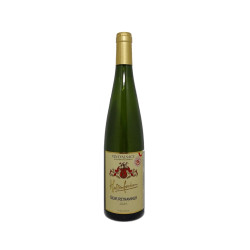


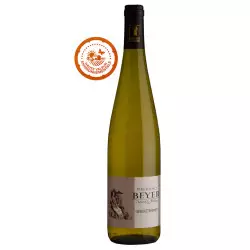


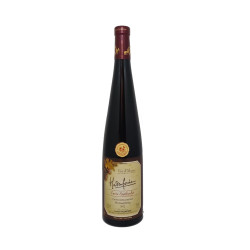


Alsace Gewurztraminer: How Ripe the Grapes Must Be
Alsace Gewurztraminer starts with very ripe grapes: the appellation sets a minimum sugar level for the harvest and caps how much fruit each vineyard plot can carry. For food, from aperitifs to Munster and Asian dishes, the pairings are listed further down this page.
Sugar and Yield: What AOC Alsace Requires of Gewurztraminer
To be labeled Gewurztraminer, an Alsace wine must come from grapes with at least 185 grams of sugar per liter of must and 11.5% natural alcohol. A white AOC Alsace with no grape name needs only 144 grams, a Riesling 160. Among whites sold under a grape name, only Pinot Gris shares this threshold.
The bar rises when the label names a place or a special designation: 193 grams and 12% for a lieu-dit (single vineyard) or geographic name, 270 grams and 16% for Vendanges Tardives (late harvest), 306 grams and 18.2% for Sélection de Grains Nobles. Those last two require overripe grapes, picked by hand and never enriched.
Volumes are tightly capped too. A Gewurztraminer plot may carry no more than 12,000 kilograms of grapes per hectare on average (about 5.4 US tons per acre), versus 14,000 for Sylvaner. Yield is capped at 80 hectoliters per hectare, versus 90 for Riesling and 100 for Sylvaner, falling to 55 for Vendanges Tardives and 40 for Sélection de Grains Nobles.
History of AOC Alsace Gewurztraminer
The AOC Alsace Gewurztraminer covers the entire Alsatian vineyard, offering wines of great diversity. These fruity and spicy white wines express themselves differently depending on the terroir and the estate. Renowned throughout France for its unique aromatic profile, AOC Alsace Gewurztraminer is available as dry, off-dry, sweet, or even dessert wines (late harvest and selection of noble grains).
Climate and Terroir of AOC Alsace Gewurztraminer
-
Climate: Alsace enjoys a semi-continental climate that is warm, dry, and sunny, thanks to its geographical location. The Vosges mountains protect the region, making it one of the driest wine regions in France.
-
Soils: AOC Alsace Gewurztraminer spans the entire AOC Alsace area, offering a wide variety of soils (granite, schist, limestone, marl, etc.).
The Essential Grape of AOC Alsace Gewurztraminer
Gewurztraminer belongs to the same family as Traminer, an old grape variety cultivated in Alsace since the Middle Ages. However, Traminer was replaced in the late 19th century by Gewurztraminer, its more aromatic form. Gewurztraminer (literally "spicy Traminer") is renowned for its exuberant aromatic profile and complexity. Early-ripening, vigorous, and low-yielding, Gewurztraminer is also notable for the pink color of its berries at maturity.
Style of AOC Alsace Gewurztraminer Wines
Color: Intense yellow with golden reflections.
Aroma: Highly fruity and aromatic, Gewurztraminer delivers intense floral aromas (especially rose), exotic fruits (lychee), citrus, and sweet spices. In sweet wines, additional notes of candied fruits and botrytis may appear.
Palate: While varying according to terroir, AOC Alsace Gewurztraminer typically produces white wines with low acidity, powerful on the palate, and often with high alcohol content for the region. In sweet versions, the palate is coated with a rich, luscious texture and pleasing sweetness.
Serving Temperature: 9°-11°C
Aging Potential: 2 to 10 years.
Best Food Pairings with AOC Alsace Gewurztraminer Wine
Here are the best food pairings to enjoy with a bottle of dry or sweet white wine from a domaine or château in AOC Alsace Gewurztraminer:
-
Dry wine: Aperitif, Asian cuisine (curry chicken), ginger shrimp.
-
Sweet wine: Foie gras, Munster, Roquefort, raspberry-lychee tart.
Common Questions About Alsace Gewurztraminer
How does Klevener de Heiligenstein differ from Gewurztraminer?
Alsace Gewurztraminer and Klevener de Heiligenstein come from two closely related grapes: Gewurztraminer and Savagnin Rose. Klevener de Heiligenstein is a geographic name within AOC Alsace, limited to five villages in the Bas-Rhin, including Heiligenstein and Obernai. Within AOC Alsace, Savagnin Rose is allowed only on the mapped plots of that name.
How far can an Alsace Gewurztraminer be chaptalized?
An Alsace Gewurztraminer whose alcohol was raised during winemaking, through enrichment such as chaptalization, can reach no more than 14.5% ABV in total. That is 2 points above a white AOC Alsace with no grape name, capped at 12.5%. With a lieu-dit or a geographic name, the limit rises to 15%.
Where does Alsace Gewurztraminer get its golden color?
The deep yellow, golden-tinged color of Alsace Gewurztraminer comes partly from its pink-skinned grapes, whose hue naturally tints the wine. The appellation lists the variety among pink grapes, marked “Rs” for rose. In Vendanges Tardives or Sélection de Grains Nobles, the color can reach amber yellow.
Where can you buy Alsace Gewurztraminer direct from the winemaker?
You can buy Alsace Gewurztraminer direct from the winemaker on Avenue des Vins. The producer packs and ships your order directly.
See also: AOC Alsace Pinot Gris - AOC Alsace Riesling - AOC Alsace Muscat