Delivery from €16,90 per winemaker in Europe (excluding the United Kingdom)


AOC Alsace Pinot Gris
On the banks of the Rhine, the winemakers of the Alsace region treat us to their finest vintages. In this region, we find the AOC Alsace Pinot Gris. Hungarian or Burgundian in origin (according to various sources), Pinot Gris (grape variety) has long been called Tokay (in reference to the Hungarian town from which it originated). The Pinot Gris appellation represents over 10% of Alsace's vineyards, and AOC Alsace wines account for 70% of the region's production, 90% of which is white.
Filtrer


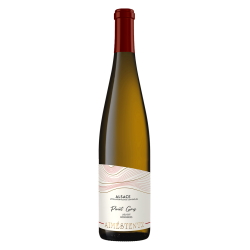


Alsace Pinot Gris: A Gray Grape, a White Wine
Pinot Gris berries range from grayish pink to grayish blue. In Alsace, this colored grape still makes a white wine, and an AOC Alsace Pinot Gris is made from Pinot Gris alone, with no other variety. The same grape also goes into several other wines from the region, under other names.
Where Else Pinot Gris Shows Up in Alsace Wine
On the label, the Pinot Gris name guarantees a wine made 100% from that grape. EU rules are looser: a wine that names a single grape must contain at least 85% of it. AOC Alsace goes further, allowing only Pinot Gris under this name and listing it among the grapes for white wines.
Beyond its own name, it can go into an Edelzwicker, an Alsace white that may combine several grapes without naming them on the label, or into a white Crémant d’Alsace. Under its own name, it can also carry the Vendanges Tardives and Sélection de Grains Nobles terms, wines made from overripe, hand-picked grapes.
Three geographic names within AOC Alsace also accept it, all in the Haut-Rhin: Côte de Rouffach, around Rouffach, Pfaffenheim and Westhalten; Vallée Noble, in Westhalten and Soultzmatt; and Val Saint Grégoire, around Turckheim. Under these names, its grapes must reach at least 193 grams of sugar per liter of must.
History of the AOC Alsace Pinot Gris appellation
The AOC Alsace Pinot Gris appellation takes us to the heart of Alsace, a wine region rich in history. Previously known as “Tokay d’Alsace”, this appellation adopted the name Pinot Gris in 2007 to better reflect its grape variety and avoid any confusion with the famous Hungarian wine. Highly appreciated for its power and complexity, Pinot Gris has experienced remarkable growth in Alsace in recent years, with its grape varieties increasing from 4 to 15% in forty years.
Climate and terroir of the AOC Alsace Pinot Gris appellation
Climate: Alsace benefits from a semi-continental climate, with hot, dry and sunny summers and cold winters. In addition, the Vosges massif allows the Alsatian vineyard to have the lowest rainfall in France.
Soils: Diversity is the key word for the Alsatian geological terroir. Indeed, limestone, granite, clay and schist follow one another, giving Pinot Gris its unique character and a wide variety of expressions.
Pinot Gris: emblematic grape variety of the AOC Alsace Pinot Gris
As its name suggests, the sole grape variety of the Alsace Pinot Gris appellation is Pinot Gris! Although it probably originates from Burgundy, Pinot Gris is a white grape variety inseparable from the Alsatian vineyard. It allows the production of white wine that is dry, semi-dry or sweet, with great complexity.
Style of the AOC Alsace Pinot Gris wine
Appearance: Deep yellow color with golden nuances.
Nose: Rich and intense aromatic bouquet with complex notes of ripe fruit, apricot, honey, spices, undergrowth and smoke.
Palate: The palate is generous, with a beautiful creamy substance. The finish is persistent on the palate and often marked by a hint of minerality (flint).
Serving temperature: 10°-12°
Aging potential: 3 to 10 years (or more for sweet wines depending on the estate or vintage)
The best food and wine pairings with an AOC Alsace Pinot Gris wine
Here is a list of the best food and wine pairings to accompany a bottle of dry or sweet white wine from an estate or château in AOC Alsace Pinot Gris:
- Dry white: salmon with sorrel, stuffed capon in the oven, asparagus risotto, royal sauerkraut
- Sweet white: foie gras, munster, Kouglof
What People Often Ask About Alsace Pinot Gris
Can an Alsace Pinot or Klevner contain Pinot Gris?
Alsace Pinot Gris can go into a wine labeled Pinot or Klevner, alongside Auxerrois, Pinot Blanc and Pinot Noir vinified as a white wine. The wine may blend these grapes or use just one. Klevner is a different name from Klevener de Heiligenstein, which comes from Savagnin Rose.
Is lieu-dit Alsace Pinot Gris hand-picked?
Alsace Pinot Gris bearing a lieu-dit (single-vineyard) name must come from hand-picked grapes. Among lieu-dit wines, the appellation imposes this only on Pinot Gris and Pinot Noir. A lieu-dit Riesling or Gewurztraminer must be hand-picked only when it carries the Vendanges Tardives or Sélection de Grains Nobles designation.
Where does the old name Tokay d’Alsace come from?
The name Tokay d’Alsace, long used for Alsace Pinot Gris, comes from a legend about vines brought back from Tokaj, Hungary, around 1565. Baron Lazare de Schwendi is said to have had them propagated in Kientzheim. Yet Hungarian Tokaji is made from Furmint, not Pinot Gris. Before 1870, the grape was called Grauer Tokayer.
Where can you buy Alsace Pinot Gris direct from the winemaker?
You can buy Alsace Pinot Gris direct from the winemaker on Avenue des Vins. Each bottle is shipped by the producer who made it, with no middleman.
See also: AOC Alsace Gewurztraminer - AOC Alsace Pinot Blanc - AOC Alsace Sylvaner