Delivery from €16,90 per winemaker in Europe (excluding the United Kingdom)


AOC Alsace Muscat
On the banks of the Rhine, the winegrowers of the Alsace region delight us with their best vintages. In this region, we find in particular the AOC Alsace Muscat. This wine is made with Muscat à petits grains (also called Muscat d'Alsace) and Muscat Ottonel and its appellation represents a little more than 2% of the Alsatian vineyard. The wine of this AOC is generally dry, very aromatic and with a fruity taste. The wines of the AOC Alsace represent 70% of the regional production and are 90% white wines.
Filtrer


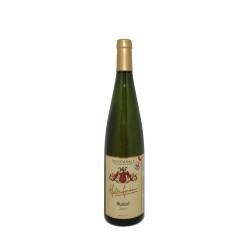


Alsace Muscat as a Lieu-Dit or Grand Cru Wine
On the label, an Alsace Muscat is named either Muscat or Muscat Ottonel. It can also name a lieu-dit (a single named vineyard), come from a grand cru or carry the Vendanges Tardives or Sélection de Grains Nobles designation. AOC Alsace’s added village and district names, by contrast, all belong to other grapes.
Higher Standards as the Label Moves Up
Whether the label reads Muscat or Muscat Ottonel, the requirements are identical. With no other name, the must needs at least 151 grams of sugar per liter at harvest, and yields stop at 90 hectoliters per hectare (about 960 US gallons per acre).
A lieu-dit raises the bar: at least 168 grams of sugar and 10.5% natural alcohol, and no more than 68 hectoliters per hectare.
Alsace’s grands crus, separate appellations, accept Muscat on most of their 51 sites, with yields capped at 50 hectoliters per hectare. The Zotzenberg excludes it; the Altenberg de Bergheim and the Kaefferkopf take it only as a minor part of a blend.
Finally, Muscat and Muscat Ottonel can carry the Vendanges Tardives and Sélection de Grains Nobles designations, for hand-picked wines whose natural alcohol is never boosted in the cellar.
History of the AOC Alsace Muscat appellation
Muscat, like Gewurztraminer or Riesling, is an emblematic grape variety of Alsace's wine heritage. Even though it covers a smaller area than other grape varieties in the region, Muscat d'Alsace has a strong identity. It is appreciated for its freshness and its characteristic aroma, reminiscent of freshly picked grapes. Unlike other wine regions, Muscat d'Alsace is generally vinified as a dry wine, emphasizing its liveliness and thirst-quenching character.
Climate and terroir of the AOC Alsace Muscat appellation
- Climate: Benefiting from a semi-continental climate thanks to the protection of the Vosges, Alsace enjoys reduced rainfall, conducive to perfect grape maturity.
- Soils: The Alsace Muscat appellation benefits from the geological diversity of the region, from granite and schist soils to limestone and marl soils, offering varied nuances to the wines depending on the terroir.
Muscat: an essential grape variety of the AOC Alsace Muscat appellation
Alsace mainly produces two types of Muscat: Muscat Ottonel and Muscat blanc à petits grains. While Muscat Ottonel is often rounder and Muscat blanc à petits grains more lively, these grape varieties both produce wines with fresh aromas of grapes, citrus fruits, flowers and exuberant exotic fruits.
Style of AOC Alsace Muscat wines
Appearance: Pale yellow color with green highlights.
Nose: The nose, very aromatic and intense, immediately evokes fresh grapes, with touches of citrus fruits, white flowers and sometimes mint. This characteristic bouquet is also called a “muscaté” aroma.
Palate: On the palate, the AOC Alsace Muscat surprises with its freshness and thirst-quenching side. In dry wine as well as in sweet white wine, the palate shows a nice acidity and a persistent finish on the fruit.
Serving temperature: 8°-10°
Aging potential: 1 to 5 years.
The best food and wine pairings with an AOC Alsace Muscat wine
The dry or sweet white wine of the AOC Alsace Muscat, due to its liveliness and fruitiness, lends itself to many pairings. Here is our advice for creating the best food and wine pairings:
- Starters: asparagus flan, fish tartare, fresh goat cheese.
- Main courses: Sushi, leek quiche, grilled fish (sardines).
- Dessert: apricot clafoutis, rhubarb tart.
Good to Know About Alsace Muscat
How does Muscat differ from Muscat Ottonel in Alsace?
The Muscat Ottonel label means an Alsace wine made from Muscat Ottonel alone. A Muscat can combine Muscat à petits grains, white or pink, with Muscat Ottonel, or use just one of them. According to the Alsace wine council, it most often blends Muscat à petits grains and Ottonel.
How long has Muscat been grown in Alsace?
Muscat à petits grains appeared in Alsace in the early 16th century, according to the Alsace wine council. Muscat Ottonel, a newer and earlier-ripening variety, only joined it in the mid-19th century.
How much sugar does an Alsace Muscat Vendanges Tardives need?
An Alsace Muscat Vendanges Tardives (late harvest) comes from grapes whose must holds a minimum of 244 grams of sugar per liter, or 14.5% natural alcohol. For Sélection de Grains Nobles, the threshold rises to 276 grams and 16.4%. Maximum yields then fall to 55 hectoliters per hectare, and to 40 for Sélection de Grains Nobles.
Where can I buy Alsace Muscat wines direct from the winemaker?
You can buy Alsace Muscat wines direct from the producer on Avenue des Vins. Each wine’s page lists the vintage and the bottle size.
See also: AOC Alsace Gewurztraminer - AOC Alsace Riesling - AOC Alsace Pinot Gris