Delivery from €16,90 per winemaker in Europe (excluding the United Kingdom)


AOC Saint-Amour
It's in the north of the Beaujolais vineyard that the Saint-Amour vines spread. Closely related to the Burgundy wines, the Gamay in the Saint-Amour controlled designation vineyard offers light but solid wines. In their first years, they offer a nose with fruity peach and apricot notes. This wine is soft, fruity and floral. When macerated longer, it has a good ageing potential of about five years. The nose will then have evolved towards spices and it will be more solid in the mouth.
Filtrer

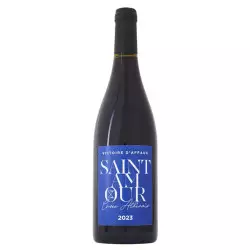


Saint-Amour: A Name Tied to a Roman Soldier’s Legend
Saint-Amour is grown in the village of Saint-Amour-Bellevue, in southern Saône-et-Loire, 12 km (7.5 miles) southwest of Mâcon and 30 km (19 miles) north of Villefranche-sur-Saône. It is the only one of the ten Beaujolais crus whose vineyard area lies entirely within this department.
Sandstone or Lower Slopes: Two Styles Shaped by the Soil
The vines grow mainly on the eastern slopes of Mont de Bessay, which rises to 478 m (1,568 ft), and the Colline de l'Église, at 310 m (1,017 ft). The plots sit between 250 and 380 m (820 to 1,247 ft) and most of them face east.
On the flank of Mont de Bessay, a layer of Triassic sandstone over schist breaks down into very poor, sandy soils. These plots tend to yield more tannic wines.
At the foot of the slopes, to the east and south, clay-silica soils, stony on the surface, lie on colluvium and alluvial fans, debris washed down from the rocks of the hills behind. They give lighter wines.
In the winery, some producers also shorten maceration to make a wine that is ready to drink sooner.
History of the Saint-Amour Appellation
Recognized since 1946, AOC Saint-Amour is one of the ten crus of Beaujolais. Located at the northern tip of the region, it owes its charming name to a local legend associated with a Roman soldier converted to Christianity. Valentine's Day is celebrated here with enthusiasm, making its wines ambassadors of love!
Climate and Terroir of the Saint-Amour Appellation
- Climate: The semi-continental climate with an oceanic influence offers warm summers and long, mild autumns, perfect for slow grape ripening.
- Soils: The terroir of AOC Saint-Amour is a mosaic of granitic, schistous, and clay-siliceous soils, which impart notable complexity to the wines of this appellation.
Gamay: The Emblematic Red Grape Variety of AOC Saint-Amour
Gamay Noir à Jus Blanc is the king grape variety of Beaujolais and particularly of the Saint-Amour appellation. This red grape, usually supple and lively, reveals a range of varied expressions depending on the estate and terroir, from the most fruity to the most complex and structured.
Style of Saint-Amour AOC Wines
- Appearance: Brilliant garnet-red color with characteristic violet hues of its youth.
- Nose: The aromas are rich in floral and fruity nuances, often evoking rose, peony, blackcurrant, strawberry, and cherry. With age, they become more complex, revealing spicy and undergrowth notes.
- Palate: On the palate, Saint-Amour presents a fine structure and velvety tannins, ending in a tender and harmonious finish, balancing refreshing acidity with a luscious fruitiness.
- Serving Temperature: 14°C to 16°C.
- Aging Potential: Saint-Amour red wines are generally appreciated in their youth for their fruity freshness, but they can also age admirably well for 2 to 5 years (or even more depending on the estate or vintage).
Best Food Pairings with Saint-Amour AOC Wine
Here are some recommendations to achieve the best food and wine pairings with a bottle of Beaujolais wine from a domaine or château in AOC Saint-Amour:
- Beef carpaccio
- Veal vol-au-vent
- Beaujolais-style saucisson en brioche
- Eggs in red wine sauce (Oeufs en meurette)
- Beaujolais-style andouillette
A Decree, a Lease and a Village: Saint-Amour Then and Now
Who Secured the Saint-Amour Appellation?
The Saint-Amour appellation was secured by the Union des producteurs, a local growers' group led by Louis Dailly that pursued recognition through the 1930s. The effort led to the decree of February 8, 1946.
What Is Métayage in Saint-Amour?
In Saint-Amour, métayage is a sharecropping lease: the grower farms a landowner's vines and splits the harvest with the owner. Locally, it dates back to the 18th century, when large estates were divided into sharecropped holdings, and it remains well established in the village.
How Much of Saint-Amour-Bellevue Is Planted to Vines?
In Saint-Amour-Bellevue, vines already covered more than half the village land in 1838: 268 of its 509 hectares (662 of 1,258 acres). The figures have changed little, with the Saint-Amour vineyard spanning about 300 hectares (740 acres) in 2010.
Where to Buy Saint-Amour Direct from the Winemaker?
You can buy Saint-Amour direct from the winemaker on Avenue des Vins. Each wine's page lists the vintage and the bottle size.
See also: AOC Juliénas - AOC Fleurie - AOC Morgon