Delivery from €16,90 per winemaker in Europe (excluding the United Kingdom)

Unbeatable !
Do you know the main wine-growing regions?
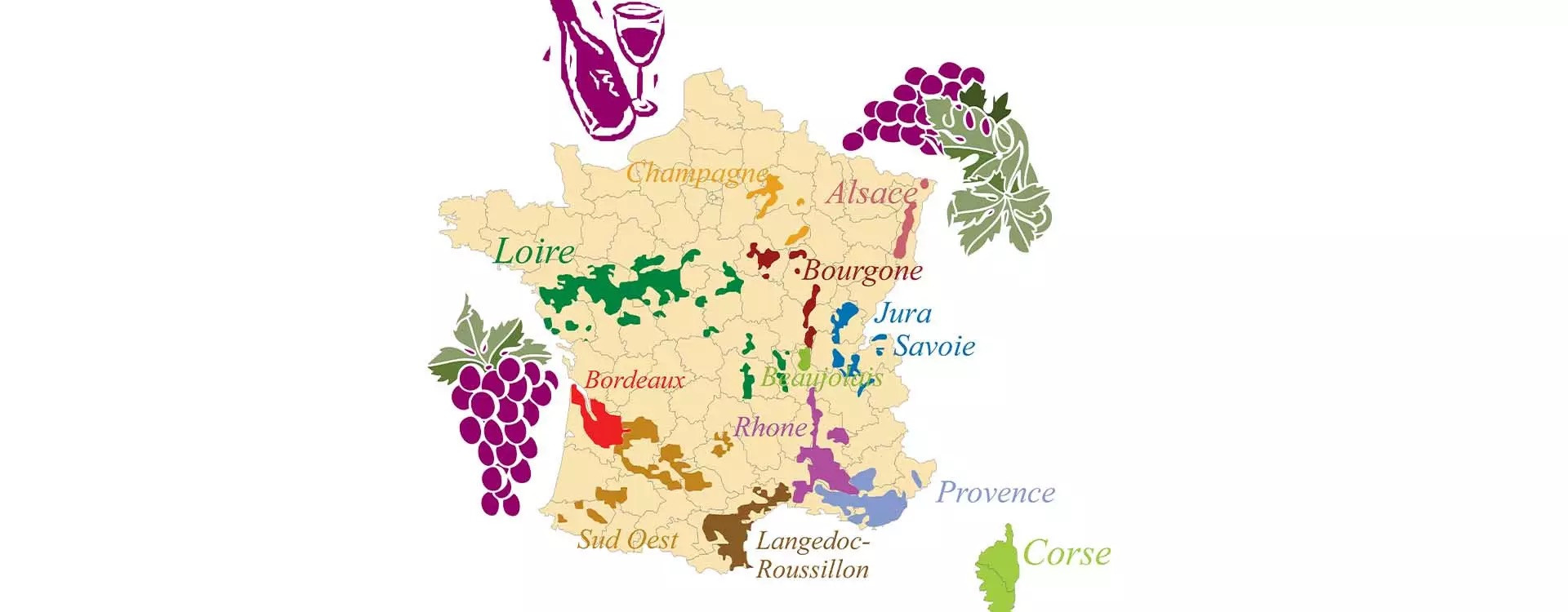
The main French wine regions: a complete guide
France is one of the richest and most diverse wine-producing countries in the world. From Alsace to Provence, from the Loire Valley to the Rhône Valley, each wine region has a unique identity shaped by its terroir, climate and grape varieties. Whether you are a curious enthusiast or a seasoned connoisseur, this complete guide presents the 13 great French wine regions, their must-know appellations and the wines they produce. On Avenue des Vins, every bottle from these regions is shipped directly from the winemaker's cellar, guaranteeing freshness and authenticity.
Alsace
Nestled between the Vosges mountains and the Rhine, Alsace is a wine region in north-eastern France with strong Germanic influences. Its vineyard stretches across 15,500 hectares along a narrow strip of land sheltered from wind and rain by the Vosges, giving it exceptional sunshine for such a northerly region.
Alsace has only three main appellations, Alsace, Alsace Grand Cru and Crémant d'Alsace, but its richness lies in the diversity of its white grape varieties: Riesling, Pinot Gris, Gewurztraminer, Muscat, Sylvaner and Pinot Blanc. Pinot Noir is the only red variety permitted. Alsace wines have the distinctive characteristic of being sold under the grape variety name rather than the appellation, a uniquely French exception.
Beaujolais
South of Burgundy, Beaujolais is a region often reduced to its famous Beaujolais Nouveau, but one that deserves far more credit. Its vineyard covers 21,000 hectares and includes 12 appellations, among them several prestigious crus: Brouilly, Morgon, Moulin-à-Vent, Fleurie and Saint-Amour.
Gamay is the king grape of Beaujolais, covering 98% of the vineyard. It produces fruity, light and easy-drinking red wines, often served slightly chilled. The Beaujolais crus are a different proposition entirely: more complex, more concentrated, with some such as Moulin-à-Vent capable of ageing for several years in the cellar.
Bordeaux
Bordeaux is arguably the world's most famous wine region. Its vineyard is the largest in France, with 119,000 hectares spread across some sixty appellations, the most celebrated being the Médoc, the Graves, Saint-Émilion, Pomerol and Sauternes.
Bordeaux red wines are produced primarily from Merlot, Cabernet Sauvignon and Cabernet Franc, often blended together. Dry whites are based on Sauvignon Blanc and Sémillon, while the sweet whites of Sauternes combine Sémillon, Sauvignon and Muscadelle to produce the world's greatest dessert wines.
Burgundy
Burgundy is France's most complex wine region, with around one hundred appellations spread across 50,000 hectares according to a four-level hierarchy: regional Burgundy, Village, Premier Cru and Grand Cru. The Côte de Beaune, Côte de Nuits, Mâconnais, Chablis and Côte Chalonnaise are its main territories.
Its strength lies in just two grape varieties: Pinot Noir for reds and Chardonnay for whites (with Aligoté and Gamay as secondary varieties). This simplicity of variety combined with extraordinary terroir complexity is Burgundy's signature: two identical vines just a few metres apart can produce radically different wines.
Champagne
Champagne is the only French wine region to have just one appellation: Champagne. Its vineyard stretches across 35,000 hectares around Reims and Épernay, on unique chalky soils that give the wines their characteristic minerality and freshness.
Three grape varieties dominate: Pinot Noir (structure and body), Chardonnay (finesse and elegance) and Pinot Meunier (roundness and fruitiness). Blanc de Blancs Champagnes are made exclusively from Chardonnay, while Blanc de Noirs are made exclusively from Pinot Noir and/or Pinot Meunier. On Avenue des Vins, our grower Champagnes are available in direct supply straight from the Champagne houses.
Corsica
Corsica is a wine world unto itself within the French landscape. Its 7,000-hectare vineyard includes 9 appellations (Ajaccio, Patrimonio, Porto-Vecchio, Calvi, Sartène, Figari...) and cultivates endemic grape varieties with names that conjure a sense of travel: Niellucciu (closely related to Tuscany's Sangiovese), Sciaccarellu and Vermentinu for whites. Corsican wines, powerful and aromatic, express a wild and authentic Mediterranean terroir.
Jura
The Jura is France's smallest wine region with only 2,000 hectares, but certainly one of its most original. Its vin jaune and vin de paille are unique in the world: vin jaune, aged under a yeast veil in barrel for more than six years, develops utterly inimitable aromas of walnut and curry.
The Jura's grape varieties are equally singular: Savagnin, Poulsard and Trousseau, complemented by Chardonnay and Pinot Noir. The appellations Arbois, Château-Chalon, L'Étoile and Côtes du Jura cover this mountain terroir of limestone and marl.
Our Wines by Region : Every French wine region in one place, direct from the growers at estate price. See the selection →
Languedoc-Roussillon
Languedoc-Roussillon is the largest wine region in France and the world, with over 220,000 hectares of vines stretching from Nîmes to the Spanish border. Long associated with high-volume table wine production, the region has undergone a remarkable quality transformation over the past thirty years.
Its many appellations, Pic Saint-Loup, Faugères, Saint-Chinian, Corbières, Minervois, Banyuls, Rivesaltes, produce powerful, sun-drenched reds based on Grenache, Syrah, Mourvèdre, Cinsault and Carignan, as well as aromatic whites and exceptional naturally sweet wines.
Provence
Provence is the world's leading rosé-producing region, and with good reason: its 27,000 hectares of sun-drenched vines produce rosés of unrivalled paleness and finesse, recognisable by their very pale salmon robe. Côtes de Provence, Bandol, Cassis and Les Baux-de-Provence are among its flagship appellations.
Provençal grape varieties are numerous: Grenache, Cinsault, Syrah and Mourvèdre for reds and rosés, Vermentino, Clairette and Ugni Blanc for whites. Bandol red wine, aged in the cellar for several years, is one of the most remarkable age-worthy wines in the South of France.
Savoie and Bugey
Perched between Alpine lakes and mountain massifs, the vineyards of Savoie and Bugey cover 3,000 hectares across 6 appellations. These are discreet, little-known regions producing fresh, lively and mineral wines, perfect with Savoyard cuisine, fondue, raclette, freshwater fish.
Jacquère is Savoie's emblematic white grape variety, accompanied by Roussanne, Altesse and Chasselas. For reds, Mondeuse produces tannic, peppery wines with a wild character. Cerdon du Bugey, a semi-sparkling pink wine, is one of the region's most original specialities.
South-West
The South-West wine region is a mosaic of terroirs stretching from Bergerac to Irouléguy, taking in Cahors, Madiran, Gaillac and Jurançon. With 33,000 hectares and 18 appellations, it is a region rich in indigenous grape varieties found nowhere else in France.
Malbec (Côt) is the star of Cahors, Tannat the backbone of Madiran, and Petit and Gros Manseng the kings of white Jurançon. These original varieties produce wines of real character, often rustic in their youth but of great complexity after a few years in the cellar.
Loire Valley
The Loire is France's longest river, and the vineyard that follows its course is one of the country's most diverse: 70,000 hectares, 69 appellations, dry whites, medium-sweet, sweet, reds, rosés and sparkling wines. It is France's leading white wine-producing vineyard.
From west to east, the terroirs shift dramatically: the Atlantic Muscadet, Anjou-Saumur with its exceptional Chenins, Touraine with its fruity Cabernet Francs, then the Centre-Loire with Sancerre and Pouilly-Fumé, two great Sauvignon Blanc wines recognised worldwide.
Rhône Valley
The Rhône Valley stretches over 200 kilometres from north to south, in two clearly distinct parts. The northern Rhône (Côte-Rôtie, Hermitage, Condrieu, Saint-Joseph) produces rare and highly sought-after wines, with Syrah as the sole red variety and Viognier for whites. The southern Rhône (Châteauneuf-du-Pape, Gigondas, Vacqueyras, Tavel) offers more generous and sun-ripened wines, made from Grenache blended with Mourvèdre, Syrah and Cinsault, across a total of 75,600 hectares.
Why buy your French regional wines direct from the producer ?
Each French wine region produces wines that tell a story of terroir, expertise and passion. At Avenue des Vins, we work directly with independent growers across all 13 of these regions. The result: bottles shipped from the estate's cellar at estate price, with complete vintage traceability, bypassing the intermediaries who inflate costs. That is the promise of direct supply applied to the full breadth of the French wine landscape.
Our Wines by Region : Every French wine region in one place, direct from the growers at estate price. See the selection →
FAQ: French wine regions
How many wine regions are there in France ?
There are officially 13 major wine regions in France: Alsace, Beaujolais, Bordeaux, Burgundy, Champagne, Corsica, Jura, Languedoc-Roussillon, Provence, Savoie-Bugey, South-West, Loire Valley and Rhône Valley. Each is subdivided into appellations (AOC/AOP), which can themselves be broken down into crus or villages.
What is the largest wine region in France ?
Languedoc-Roussillon is the largest wine region in France, with over 220,000 hectares of vines, ahead of Bordeaux (119,000 ha) and the Loire Valley (70,000 ha).
What is the best wine region in France ?
There is no single "best" wine region: it all depends on personal preference. Bordeaux is renowned for its powerful, age-worthy wines, Burgundy for its finesse and Grand Crus, while the Loire and Beaujolais offer more accessible, fruit-driven wines.
Which French regions produce the best red wines ?
The most celebrated red wines come from Bordeaux (powerful blends), Burgundy (elegant Pinot Noir) and the Rhône Valley (Syrah and Grenache). The South-West also offers wines of real character, such as those from Cahors and Madiran.
Which French region is known for white wine ?
Alsace is the reference for aromatic white wines, the Loire for freshness and diversity, and Burgundy for its great Chardonnays. These regions produce some of the finest white wines in the world.
Which region produces the best rosé wine in France ?
Provence is the essential region for rosé wine. Its wines are renowned for their finesse, freshness and delicate aromas, making them a world reference for the style.
How do I choose a wine region based on my taste ?
For powerful wines: Bordeaux or the Rhône. For elegant wines: Burgundy. For fresh and fruity wines: the Loire or Beaujolais. For aromatic wines: Alsace. On Avenue des Vins, you can filter by region and find the perfect bottle for your taste, shipped directly by the grower.
Where can I buy wines from all French regions ?
On Avenue des Vins, you can discover a selection of wines from all French regions through direct producer supply. Every bottle is shipped from the estate's cellar, with complete vintage traceability and prices with no middleman.
From Alsace to Provence, from Beaujolais to the Languedoc: the French vineyard is an inexhaustible source of discovery. Each region tells a story of terroir, climate and winemaking expertise. The best way to explore them is still to taste them - directly from the producer's cellar, at estate price.


