Delivery from €16,90 per winemaker in Europe (excluding the United Kingdom)

Portraits of winemakers
Château Palais Cardinal: the history, precision, and soul of Saint-Émilion
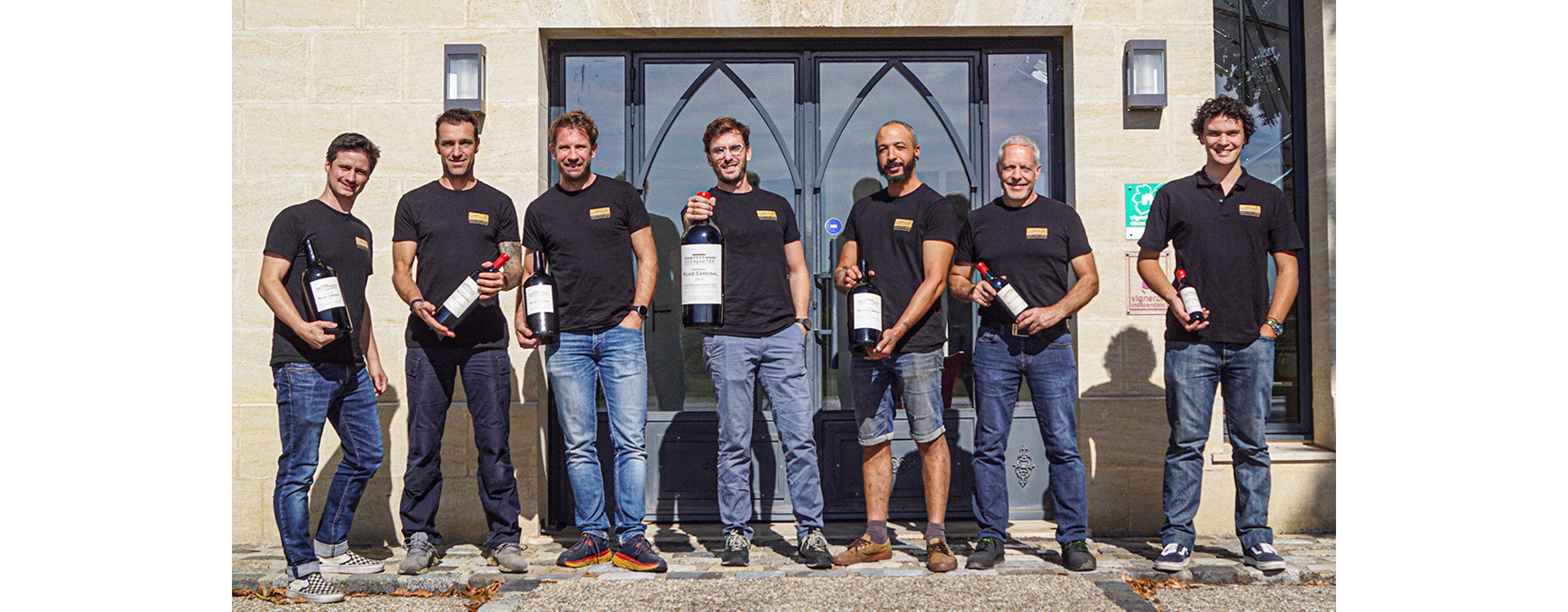
Some estates have names that are enough to tell the story of a place. Château Palais Cardinal is one of them. Its history dates back to the 12th and 13th centuries, when an old residence stood near the Porte Bourgeoise, at the northern entrance to Saint-Émilion. In the 14th century, Cardinal Gaillard de la Motte nephew of Pope Clement V enlarged the building, and the name Palais Cardinal became permanently anchored in the memory of the village.
Available directly from the estate on Avenue des Vins.
What is the story behind the estate's name?
A name shaped by seven centuries of history
The vineyard stretches south of Saint-Émilion, in the commune of Saint-Sulpice-de-Faleyrens, on gravel and sandy soils naturally drained by the La Fuite stream. It is a vibrant, finely balanced terroir that gives the wines an elegance typical of Bordeaux’s Right Bank.
In 2018, the Ballande family acquired the estate and began a new chapter in its development. Today, the vineyard covers 26 hectares, managed by an experienced team alongside oenologist Thomas Duclos. The ambition is both simple and demanding: to fully reveal everything this terroir has to express.
Our estate is all about balance: respect for history, with an eye firmly on tomorrow.
How did the passion for wine take hold?
The wine bug? A passion that settled in quietly
Some winemakers speak of a sudden revelation a glass tasted at fifteen, a decisive harvest. Not here. At Château Palais Cardinal, the passion for wine came gradually, quietly, like a vintage slowly taking shape in the cellar.
At first, there was respect for an exceptional terroir and for those who had worked it before. Then came the first comparative tastings, the first harvests experienced from the inside, and the understanding that every decision sometimes a tiny one changes what ends up in the glass. But the real turning point happened in the cellar.
When you taste a barrel that is still evolving and you can feel the potential, the tension, the balance taking shape, that is when you understand that wine is alive.
Since then, it has become what he himself calls a positive obsession: seeking greater finesse, understanding each vintage more deeply, and moving forward without ever betraying the identity of the place.
Which memories stand out the most?
That first morning in front of the team
Among all the memories of the estate, two stand out with particular intensity. The first is humble, almost discreet and perhaps that is exactly why it has stayed.
His first harvest as head of the estate. He knew the figures, the yields, the objectives. But standing before teams who had already been there for years, something became clear to him that morning: wine is never led alone.
I watched. I listened. I learned. Since then, every vintage has been a dialogue: between past and future, between the team’s experience and my desire to explore further.
The second memory is no more linked to an award or a score. It was the day when, after tasting a vintage still ageing, the entire team looked at one another in silence. Nothing needed to be added. The balance was there. The finesse too. They knew they had reached a new milestone.
What I felt was pride. Not individual pride, but collective pride. And also a form of humility because wine remains alive and unpredictable.
How are the wines made?
Eight cuvées, one common thread: precision
At Château Palais Cardinal, they do not make just one wine. Today, they craft eight different cuvées, each with its own personality an amphora-aged wine, a rosé, a clairet, a Blanc de Noirs, a low-sulfite wine without ever losing sight of the common thread: precision, balance and respect for the fruit.
Everything begins in the vineyard, plot by plot, with one deeply held conviction:
You can never make up in the cellar for what was not done properly in the vineyard.
Harvesting is carried out by hand or by machine, depending on the real needs of each terroir. The soils are worked mechanically. Yields are kept under control. And in the cellar, intervention remains measured: stainless steel tanks to preserve purity, ageing in barrels, amphorae or vats depending on what the wine requires. Always with the idea of guiding, never disguising.
The classic Right Bank blend is there Merlot for flesh and depth, Cabernet Sauvignon for structure, Cabernet Franc for freshness but the estate continues to explore, to question, to move forward. A vineyard restructuring program has been underway for several years, aiming to bring the vines to their highest potential. And in 2026, olive trees will be planted alongside a few beehives, to produce high-quality olive oil and honey.
The wine that best sums all of this up? Palais Cardinal itself, according to its director:
A straightforward, precise wine, without unnecessary showmanship. It does not seek to impress through power, but through balance and finesse. Palais Cardinal is not a wine that shouts. It is a wine that asserts itself.
Discover the Château Palais Cardinal cuvées directly on their Avenue des Vins storefront shipped straight from the estate through a short supply chain.
Why buy directly from the winemaker? The wines of Château Palais Cardinal are shipped straight from the estate: estate price with no middleman, full vintage traceability, and your support for an independent winegrowing family.
Discover the wines of Château Palais Cardinal directly from the estate, at the estate price, in a short supply chain on Avenue des Vins.
Frequently asked questions about Château Palais Cardinal
Where is Château Palais Cardinal located?
The estate sits on Bordeaux's Right Bank, in Saint-Sulpice-de-Faleyrens, just south of Saint-Émilion. Its 26 hectares rest on gravel and sandy soils crossed by the La Fuite stream.
Which grape varieties go into the wines?
The wines draw on the classic Right Bank trio. Merlot brings flesh and depth, Cabernet Sauvignon lends structure, and Cabernet Franc adds a touch of freshness.
Who owns the estate today?
The Ballande family has owned the property since 2018. They rely on an experienced team and on oenologist Thomas Duclos to run the vineyard day to day.
How many cuvées does the estate produce?
Eight cuvées currently come out of the cellar, including an amphora-aged wine, a rosé, a clairet, a Blanc de Noirs and a low-sulfite bottling.
What style of wine does Château Palais Cardinal make?
The estate aims for straightforward, precise wines built on balance and finesse rather than sheer power. Ageing takes place in barrels, amphorae or vats depending on what each cuvée needs.