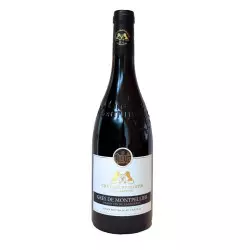
Château Paul Mas "Clos de Savignac"
Château Paul Mas - Domaines Paul Mas Languedoc Roussillon
€18.50


In the south of France, the very sunny vineyard of Languedoc-Roussillon extends over more than 240,000 hectares from Nîmes to Leucate (Aude), making it one of the largest vineyards in the world. It includes the AOC Grès de Montpellier. The appellation area of this AOC extends over the territory of 45 communes around Montpellier on some 1,000 hectares of soils partly sandstone, also composed of alluvium, silica, limestone, sand and marl. Grenache, Mourvèdre, Syrah, Cinsault and Carignan vines, subject to the Mediterranean climate of this geographical area, are planted in this appellation and produce red wines. These wines with silky tannins are fine and express aromas of red fruits and garrigue.
Filtrer
Château Paul Mas "Clos de Savignac"
Château Paul Mas - Domaines Paul Mas Languedoc Roussillon
Grès de Montpellier has been an AOC in its own right since 2024, and it covers red wines only. Its area forms an amphitheater facing the Mediterranean and backed by the Cévennes foothills, between the Hérault valley to the west and the Vidourle valley to the east, with the city of Montpellier at its center.
In Occitan, the old regional language of southern France, “grés” means poor, stony hillside land. The appellation’s name refers to a kind of ground, poor and stony but deep, more than to one particular rock.
Sandstone, the rock, is still part of the subsoil, along with conglomerates, molasse, terraces of rounded pebbles, marl, and limestone broken into small shards. Vines grow at 100 to 985 feet (30 to 300 meters), on free-draining soils that store the day’s heat and release it at night.
Near the coast, vines cover gently rounded hills; farther north, on the hillsides, they mingle with garrigue, the local scrubland of holm oak, Aleppo pine and rockrose.
South of Montpellier, in Lattes, excavations at the ancient port of Lattara uncovered a limestone pressing platform dated to around 425 BCE. Chemical analysis found traces of grapes on it: wine was already being made there.
In the 18th century, wine châteaux and “folies montpelliéraines,” country houses built for leisure, were surrounded by large vineyards. Several of them still make wine under the appellation.
In the 19th century, the painters Frédéric Bazille and Gustave Courbet depicted the vine-covered hillsides around Montpellier; the city’s Musée Fabre holds works by both artists.
Every vineyard in the appellation lies within 25 km (about 15 miles) of the coast. In summer, sea breezes blow across the plots every day: they air out the vines, ease temperature swings and let the grapes ripen slowly.
To the north, the Cévennes foothills block the north wind. During ripening, day and night temperatures still differ by 20 to 22°F (11 to 12°C), and 24 to 31 inches (600 to 800 mm) of rain fall each year, with very dry summers.
These conditions shape the appellation’s style: a deep ruby color, a nose of red and black fruit, garrigue and spice, often lifted by a hint of tapenade, then a full palate. The tannins are silky and the wines show finesse; the appellation credits its reds with strong aging potential.
Grès de Montpellier became an AOC in its own right through a French government order dated May 14, 2024. It had been recognized in 2003 as a subzone of AOC Coteaux du Languedoc, today’s AOC Languedoc, which it no longer belongs to.
Grès de Montpellier brings together at least two of its three main grapes, Grenache, Mourvèdre and Syrah, which make up half the wine or more. Carignan, Cinsault and Morrastel may be added; one grape alone tops out at 80%.
In Grès de Montpellier vineyards, the grass between rows is kept in check by mechanical or physical means. Chemical weeding of the headlands, the row ends where machines turn, is banned, as are plastic mulch and soil brought in from outside the appellation’s plots.
You can buy Grès de Montpellier, sold by the producer, on Avenue des Vins. Each order is prepared and sent by the producer, not from a warehouse.
See also: AOC Languedoc - AOC Terrasses du Larzac - AOC Languedoc-Pézenas