Delivery from €16,90 per winemaker in Europe (excluding the United Kingdom)

Portraits of winemakers
Domaine Sandrine Henriot, Régnié-Durette: nine plots of Gamay farmed biodynamically to Demeter
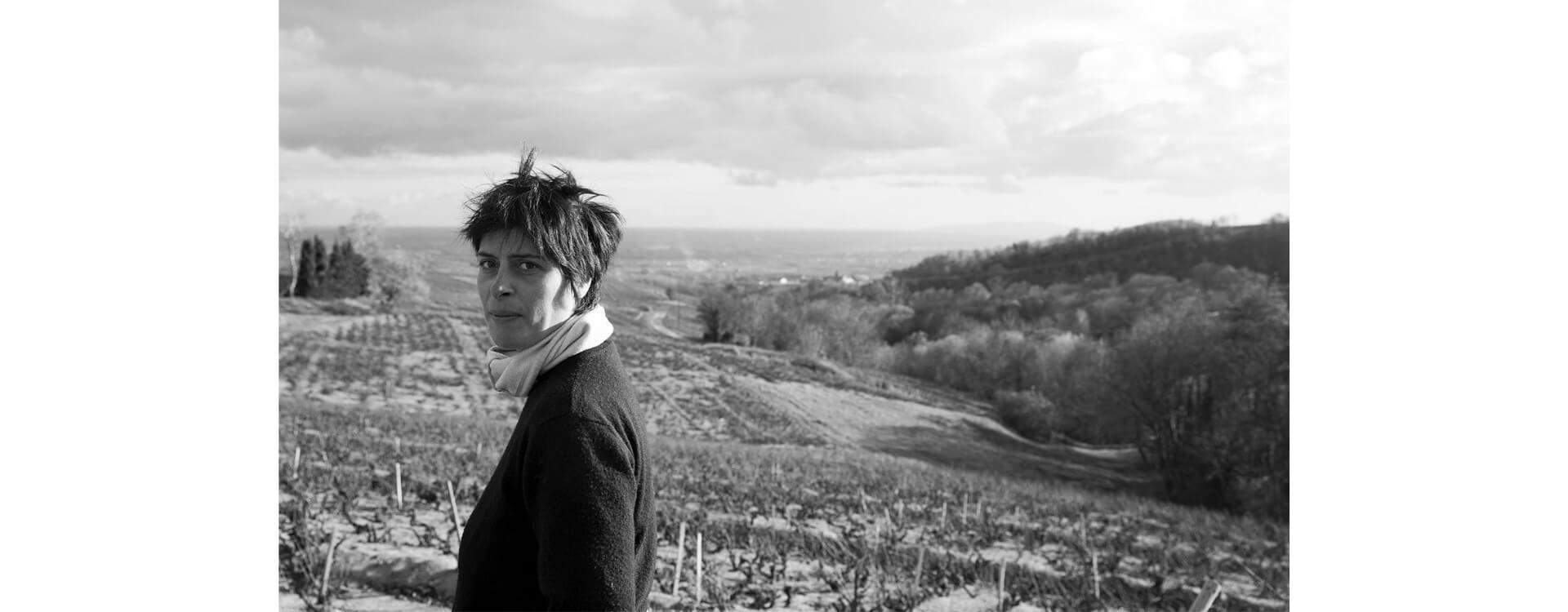
At Régnié-Durette, in the north of Beaujolais, Sandrine Henriot farms three hectares of Gamay in nine plots. She works biodynamically, organic farming taken further and timed to natural cycles, on a Demeter-certified estate she took over in 2018.
How would you describe Domaine Sandrine Henriot?
Three hectares in nine plots, three appellations and a pétillant naturel
The estate covers little ground, and comes in many pieces.
“My estate covers 3 hectares, across 9 plots.”
Those nine plots span three Beaujolais appellations, Beaujolais-Villages, Régnié and Morgon, plus a pétillant naturel, a sparkling wine bottled before fermentation has finished.
The base is at Régnié-Durette, one of the two villages of the Régnié cru, all farmed biodynamically under the Demeter label.
“Working on my own, the family is inevitably caught up in the life of the estate.”
The word she picks for the property is familial. She runs the nine plots alone.
When did you catch the wine bug?
A history degree, then training to take over an estate
She grew up in Burgundy, with bottles on the table at family celebrations and winegrowers dropping by.
“Wine is the only product you can talk about for so long among guests at a table.”
Her studies did not lead to the vine: she read history, then switched to a course for people who want to take over a wine estate.
“I certainly needed something concrete.”
She found it at Régnié-Durette in 2018, on vines already farmed biodynamically and Demeter certified since 2010.
So she had nothing to convert.
What philosophy guides your work in the vineyard and in the cellar?
Plant teas, to bring copper and sulphur down
In the vineyard, the line is read in the sprayer.
“I use a lot of plant teas in the vineyard to fight disease, in order to cut back the doses of copper and sulphur.”
A tea here is a plant steeped in water and sprayed on the leaves at high dilution. Copper and sulphur remain the two basic treatments organic farming allows against downy and powdery mildew, and since copper builds up in the soil, every dose that is saved counts.
In the cellar, the rule fits in one sentence.
“In the cellar, I work with no additives apart from low doses of sulphites.”
Whole bunches macerate for seven to ten days without punching down, then age in stainless steel or in jars. The soils are worked with a straddle tractor and a horse, and hedges and small groves line the plots.
Which wine best represents your estate?
The cuvée L'humeur vagabonde, and Gamay as the only signature
Asked which wine sums up her estate, she picks the cuvée L'humeur vagabonde, a Morgon, a cru that takes its name from the village of Villié-Morgon.
The grape never changes.
“Gamay, of course”
Gamay signs all three appellations, and it is also the only main variety the Régnié rulebook allows, the others tolerated as minor additions.
The Guide Hachette gave her Morgon 2018 two stars in its 2021 edition. She sees these wines with meat in a sauce, and opens a Régnié among friends.
Which memory at the estate has marked you most?
Her first stirring, after years spent reading about it
The memory she keeps is neither a harvest nor an award.
“My first dynamisation.”
Dynamisation means stirring a preparation diluted in water until a vortex forms, breaking it, then starting again the other way, and she had read about it for years before having her own vines.
What holds her is not repeating the same gestures, but the way soil and weather question them every year.
“Working with living things means there is never any routine, and it calls for constant self-questioning.”
Twelve months of work, and everything starts from nothing again.
Why follow Domaine Sandrine Henriot?
One plot turning to agroforestry, and whites vinified together
Because one of the nine plots is about to change its face.
“I have an agroforestry project on a plot I am going to replant.”
Agroforestry brings trees into the crop: rows inside the vineyard that cast shade, hold the soil and shelter useful insects.
The plot carries Gamay today, and the estate has no white on its list, so she will plant several white varieties there, choosing them this winter, and vinify them together.
A first white, then, and trees between the vines. Two projects at once on three hectares run by one woman: a lot, and the reason to watch what comes next.
Why buy directly from the winemaker? The wines of Domaine Sandrine Henriot are shipped straight from the estate: estate prices with no middleman, vintage traceability and support for a Beaujolais winegrower committed to Demeter biodynamics.
Explore the wines of Domaine Sandrine Henriot straight from the estate, at estate prices, through the short supply chain on Avenue des Vins.
Frequently asked questions about Domaine Sandrine Henriot
How are biodynamic preparations stirred before spraying?
The water and the preparation are stirred until a deep vortex forms, that vortex is broken to create disorder, then the movement starts again the other way.
Why do growers spray plant teas on their vines?
To help the vine resist disease and lighten treatments. Horsetail, nettle or willow are steeped or boiled down, then sprayed at high dilution. They do not replace copper, they cut the dose.
Was Régnié recognised later than the other Beaujolais crus?
Yes, only in 1988, by decree of 20 December, decades after the other nine. It covers two villages in the Rhône, Régnié-Durette and Lantignié, and makes red wine only.
Does a Régnié drink like a Morgon?
Not quite. Same grape, Gamay, but two bedrocks: Régnié sits mostly on granite, while Morgon comes off weathered schist and is credited with about ten years of ageing.
How much Chardonnay is grown in Beaujolais?
Not much. It is the only variety the Beaujolais blanc and Beaujolais-Villages blanc appellations allow, but white stays a small share of the region next to Gamay.