Delivery from €16,90 per winemaker in Europe (excluding the United Kingdom)

Portraits of winemakers
Domaine Paul Janin et Fils, five generations of Moulin-à-Vent
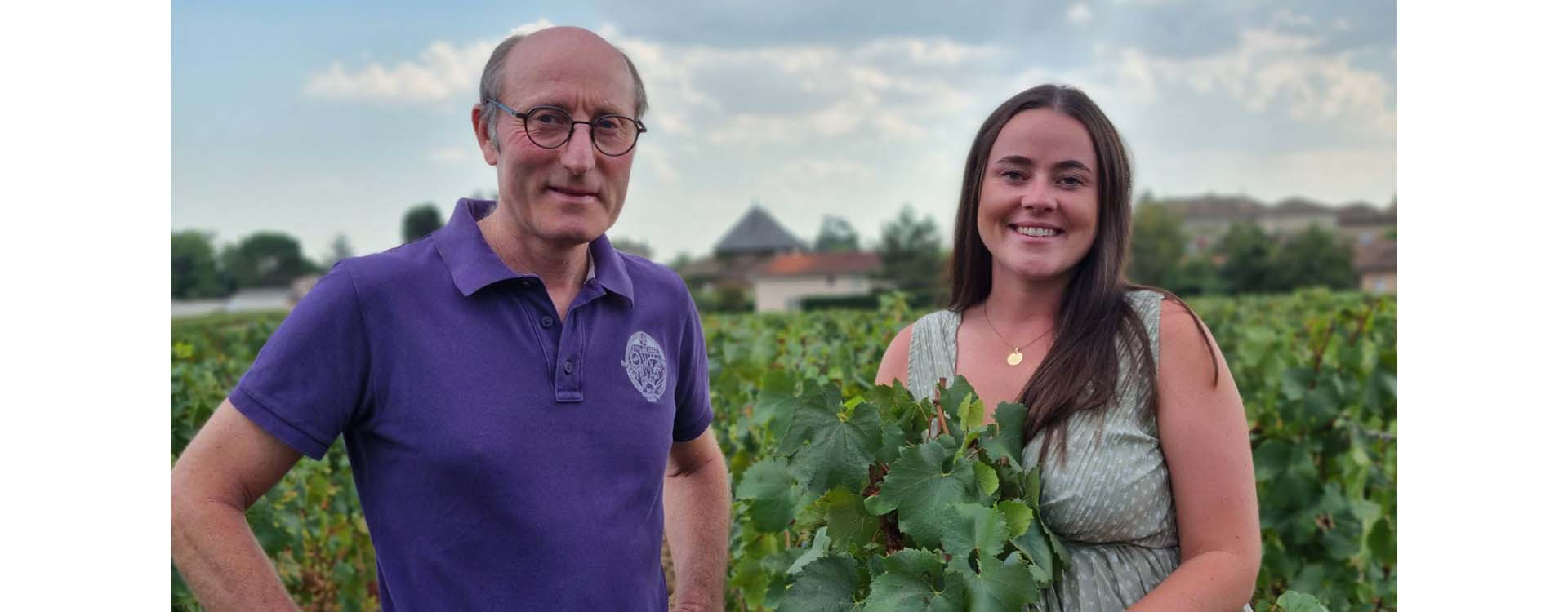
In Romanèche-Thorins, in Saône-et-Loire, the Domaine Paul Janin et Fils has grown Moulin-à-Vent for five generations. A family story that began in 1937, carried today by Éric and Perrine, faithful to direct sales and certified organic since 2024.
How would you describe the Domaine Paul Janin et Fils?
Five generations of Moulin-à-Vent in Romanèche-Thorins
The Domaine Paul Janin et Fils is a family estate based in Romanèche-Thorins, in Saône-et-Loire, at the heart of the Beaujolais. Since 1937, the family has farmed its land and made Moulin-à-Vent, as well as Beaujolais-Villages.
It all began with the great-great-grandfather, Jean-Claude, who bought his first plots at the place known as Le Tremblay. A few years later, he chose estate bottling and direct sales, convinced that the bond with those who taste his wines was essential.
At home, the word "domaine" evokes the land you own and pass on. But in French it also holds the word "main", the hand: the hand that works, that tends, that shapes. Our vines are our raw material, our hands are our signature.
From Jean-Claude to Marcel, from Marcel to Paul, then from Éric to Perrine, each generation has added its stone to the building. The story continues today with Éric and Perrine, who work side by side: two generations, one shared standard.
How did wine come into the family?
A passion handed down from generation to generation since 1918
For the Janin family, it is hard to point to a single moment: wine has been in the family since 1918. You are born among the vines, the harvests and the gestures of the craft, and you learn very early to read the vine, to understand the seasons and to gauge the work required.
The passion therefore came naturally, because it had always been there. The question of doing another job never really arose.
It is a family story, but above all a story of transmission: what we received from the previous generation, we are keen to keep alive, to let evolve and, tomorrow, to pass on in our turn.
This transmission is not only an inheritance: it is a thread that links yesterday's plots to today's choices.
What philosophy guides your work in the vines and the cellar?
Listening to nature, from biodynamics to organic certification in 2024
The estate's philosophy rests above all on listening to and understanding nature. The idea: to know the soils, the environment and the vine better, in order to work with them rather than against them. As early as the 1990s, Éric trained in agronomy, soil study and biodynamics.
Today, our goal is to preserve the right balance between the vine, its soil and its environment. This goes through an ever more respectful viticulture, which naturally led us to the official conversion to organic farming, with the AB certification obtained in 2024.
The estate's philosophy also means knowing how to adapt: nature decides, and each vintage calls for observing, thinking and sometimes breaking with habit. In 2020, longer ageing revealed a new expression of the wines. Making wine here means observing, understanding, respecting and accompanying, without ever imposing.
Which cuvées make up the estate's range?
Single-plot Moulin-à-Vent and a Beaujolais-Villages
The range of the Domaine Paul Janin et Fils brings together several Moulin-à-Vent wines: Empreinte, Héritage and Vignes du Tremblay, the last echoing the plot where it all began.
The estate also makes a Beaujolais-Villages, Piémont, and offers two gift sets to discover its cuvées. All carry the same family signature, from gamay worked plot by plot.
Why does the estate farm organically?
A conversion born from listening to the living world, AB-certified in 2024
The move to organic is not a sudden turn: it extends a long-standing practice of observing the soils and respecting the vine. This ever more attentive viticulture led the estate to official conversion, with the AB certification obtained in 2024.
The logic stays the same with each vintage: nature decides, and the work is to accompany it. Some choices born from constraints, such as longer ageing, turned into discoveries. The estate has learned to welcome these surprises as opportunities.
Why follow the Domaine Paul Janin et Fils?
A family story of land, transmission and Moulin-à-Vent
Following the Domaine Paul Janin et Fils means supporting a family that has written Moulin-à-Vent for five generations, from Jean-Claude to Perrine, without ever losing its bond with the land.
It also means following an estate that keeps moving forward: from the estate bottling chosen at the very start to the organic certification of 2024, the same standard is handed down, from the Beaujolais terroir to the glass.
Why buy directly from the winemaker? The wines of the Domaine Paul Janin et Fils are shipped straight from the estate: estate prices with no middleman, vintage traceability and support for a family of winemakers committed to their terroir.
Explore the cuvées of the Domaine Paul Janin et Fils directly from the estate, at estate prices, through the short supply chain on Avenue des Vins.
The wines of the Domaine Paul Janin et Fils: direct from the estate, at the estate price, with no middleman. See the wines →
Frequently asked questions about the Domaine Paul Janin et Fils
Where is the Domaine Paul Janin et Fils located?
The estate is based in Romanèche-Thorins, in Saône-et-Loire, at the heart of the Moulin-à-Vent appellation, in the Beaujolais.
For how many generations has the Janin family made wine?
Five generations have followed one another, with vines farmed since 1937 and wine present in the family since 1918, from Jean-Claude to Marcel, Paul, Éric and Perrine.
Are the estate's wines organic?
Yes. The estate undertook an official conversion to organic farming and obtained the AB certification in 2024.
Which appellations does the estate produce?
The estate mainly produces Moulin-à-Vent, as well as Beaujolais-Villages.
What are the estate's cuvées?
In Moulin-à-Vent, there are the Empreinte, Héritage and Vignes du Tremblay cuvées, and in Beaujolais-Villages the Piémont cuvée, rounded out by two gift sets.