Delivery from €16,90 per winemaker in Europe (excluding the United Kingdom)

Unbeatable !
Everything you need to know about champagne in 3 minutes
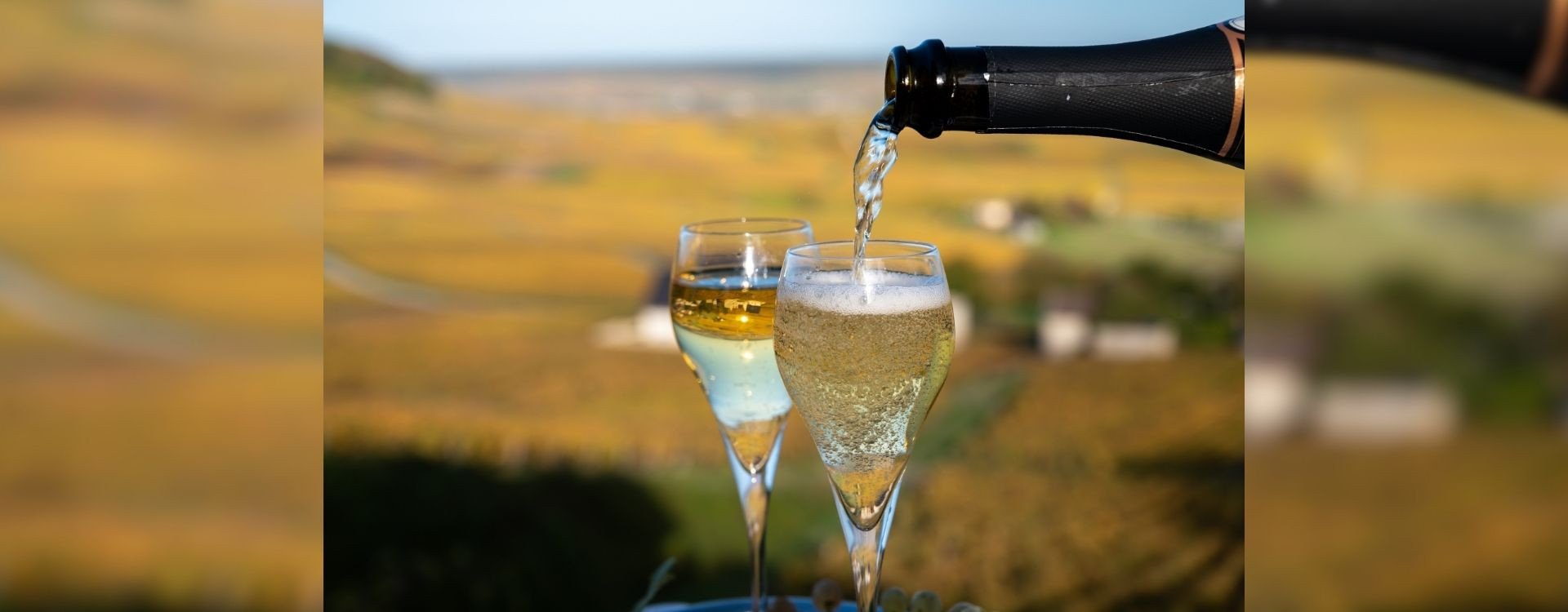
Absolutely! The sound of a Champagne cork popping is one of those iconic, celebratory noises that immediately signals a special occasion. It’s a joyful and festive sound, often associated with moments of celebration and cheer. Whether it’s at a New Year’s Eve party, a wedding, or just a spontaneous toast with friends, that pop is like an auditory high-five, marking the start of something exciting.

What exactly is Champagne?
To learn everything about Champagne in three minutes, start with the definition: a sparkling wine, white or rosé, made under a controlled designation of origin in a defined area of north-eastern France. The AOC dates from a decree of 29 June 1936.
The bubbles come from a second fermentation inside the glass bottle, the prise de mousse. From the 75cl bottle up to the magnum, the wine is sold in the very bottle where it took place. One more rule of the appellation: grapes must reach the press as whole bunches, so picking is done by hand.
Brut, extra-brut, sec, demi-sec or doux: what does the scale mean?
These words tell you how much sugar the wine holds per litre, added just before corking through the dosage liqueur, cane sugar dissolved in wine. Brut or doux Champagne is above all a matter of dosage.
Brut nature: under 3 grams of sugar per litre, with no sugar added. Extra-brut: 0 to 6 grams. Brut: under 12 grams.
Extra-dry: 12 to 17 grams. Sec: 17 to 32 grams. Demi-sec: 32 to 50 grams. Doux: over 50 grams. Nine Champagnes out of ten are brut.
Why are some Champagnes vintage?
Because the year was judged outstanding. A vintage Champagne is made only from grapes picked in the year on the label, with no reserve wines, those still wines set aside from earlier harvests. A non-vintage brut, by contrast, blends several harvests so that each bottle tastes like the last.
The appellation rules also demand more patience. Allow at least fifteen months of ageing for a non-vintage Champagne, thirty-six for a vintage, from the tirage, when the wine goes into the bottle.
Blanc de blancs, blanc de noirs, rosé: what is the difference?
The grapes make the difference. Three varieties dominate the vineyard: pinot noir and meunier, both black-skinned, and white-skinned chardonnay. Pressed without maceration, black grapes give a clear juice, which is why most Champagnes are white.
A blanc de blancs comes from white grapes alone, chardonnay in almost every case. A blanc de noirs blends pinot noir and meunier, or just one of them. Rosé comes either from macerating black skins or from adding a little red Champagne wine before the prise de mousse.
Our Champagne Selection : Our champagnes from independent growers, shipped at grower prices. See the selection →
Grand cru, premier cru: what does it change?
The term tells you about origin, not about dosage or style. In Champagne, a cru is a village: seventeen villages may print "grand cru" on the label and forty-two others "premier cru", provided the grapes come from those villages.
A Champagne with no such mention, from another village, can be just as carefully made: the grower's work counts at least as much as the name of the commune.
RM, NM, CM: how do you read the small letters on the label?
Look for two letters in front of a number, in small print: they tell you who made the wine. RM, récoltant-manipulant, is a grower who only vinifies grapes from his or her own vines. NM, négociant-manipulant, tops up its harvest with purchased grapes, musts or wines: the status of the big houses.
CM stands for a cooperative, RC for a grower whose cooperative makes the Champagne, ND for a merchant buying finished bottles, and MA for a buyer's own brand, a supermarket label for instance.
Does Champagne keep for long?
Champagne is sold ready to drink: its cellar ageing is done before it leaves the producer. You can still keep it for several years, upright or on its side, at a steady 10 to 15°C, out of the light and away from smells.
A vintage will wait longer than a non-vintage brut. After delivery, let the bottle rest for a few days before opening it.
What temperature should Champagne be served at, and in which glass?
Between 8 and 10°C, chilled but not ice-cold: too cold, and the aromas shut down. As for the glass, the Comité Champagne recommends a tulip shape, tall, rounded at the base and narrower at the rim, over the flute, too narrow, or the coupe, too open.
Pour in two stages, a small amount first, then fill to two-thirds. A glass rinsed in hot water, without detergent, keeps a finer stream of bubbles.
Grower Champagne or big house: which should you choose?
Both have their place, depending on what you want. A big house, operating as a négociant, tops up its own vines with purchased grapes and works on a large scale, with a recognisable signature. A récoltant-manipulant grower farms his or her own plots, in much smaller volumes, and the Champagne speaks of one village, sometimes one grape.
On Avenue des Vins, these Champagnes from independent growers ship direct from the estate at the price the grower sets, including a selection under €25.
Our Champagne Selection : Our champagnes from independent growers, shipped at grower prices. See the selection →
FAQ - Everything about Champagne
What does "cuvée" mean on a bottle of Champagne?
The word has two meanings. At the press, the cuvée is the first 2,050 litres of juice drawn from a marc, a load of 4,000 kilos of grapes. The next 500 litres, the taille, have a different character. On the label, "cuvée" simply names a specific blend chosen by the producer.
Can you keep an opened bottle of Champagne?
Yes, for a day or two, provided you reseal it at once and put it in the fridge. You need an airtight stopper, a metal cap with a rubber ring that clips under the lip of the neck: the original cork, swollen on opening, will not go back in. Beyond that, the bubbles fade and the wine loses its freshness.
How many flutes are there in a bottle of Champagne?
Six on average from a standard 75cl bottle, in 12.5cl flutes. The number varies with the size of the glasses and how generously you pour. A magnum holds 1.5 litres, so twice as many, and according to the Comité Champagne it ages the wine better than a standard bottle.
How do you chill a bottle of Champagne quickly?
Stand it in a bucket filled half with water and half with ice, about thirty minutes before serving. Otherwise, place it at the bottom of the fridge a few hours ahead. The fridge is for chilling, not for keeping: it is the wrong place to store a bottle for any length of time.
Can Champagne be organic?
Yes. The AB label, France's organic certification, attests to vine-growing without synthetic products. Demeter and Biodyvin certify biodynamics, a stricter organic approach tuned to natural cycles. Other mentions, such as HVE (high environmental value) or VDC (sustainable viticulture in Champagne), point to a certified environmental commitment without being organic.


