Delivery from €16,90 per winemaker in Europe (excluding the United Kingdom)


Cognac-Armagnac
Cognac and Armagnac are two wine eaux-de-vie produced in the Nouvelle-Aquitaine and Occitanie regions of France, recognized by Appellations d'Origine Contrôlée (AOC) and differentiated by age. Cognac, known for its finesse and elegance, is made almost exclusively from Ugni Blanc grapes, and is obtained after double distillation. Armagnac, one of the world's oldest spirits, can be made from 10 grape varieties (including Ugni Blanc, Baco and Colombard) and most often undergoes a single distillation. The typicality and aromas of these spirits (heat, cooking, pastry, candied fruit, animal, rancio, etc.) make them so appealing. A glass of Cognac or Armagnac is a true moment of tasting, alone or with others, around the nuggets of our French winegrowers and producers.
Filtrer

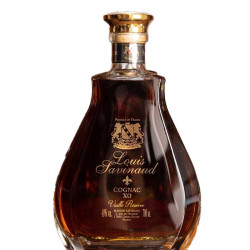


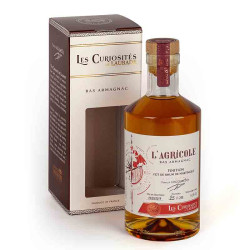
Charentais or Armagnac Still: Two Wine Brandies
Cognac and Armagnac start from the same place, a wine that gets distilled, then part ways at every step: the region, the grapes, the still, and even the way age is written on the label. Comparing them point by point helps you read a bottle before you buy it, and know which of the two you are after.
Two Vineyards, Two Grape Lists
Cognac comes from the Charentes: its area covers villages in Charente and Charente-Maritime, plus a few in Dordogne and Deux-Sèvres. Armagnac comes from Gascony, across 245 villages in the Gers, 29 in the Landes and 18 in Lot-et-Garonne, split from west to east into Bas Armagnac, Armagnac Ténarèze and Haut Armagnac.
Ugni Blanc appears on both grape lists and covers nearly 98% of the Cognac vineyard; Colombard and Folle Blanche are allowed on both sides too. Baco Blanc goes only into Armagnac: bred in 1898 by François Baco, a grape expert from the Landes, it stands up well to disease and suits sandy and silty soils.
Double Distillation or Column: Two Ways to Distill
In both appellations, distillation must be finished by March 31 after the harvest, so that no wine is distilled after being kept too long. Cognac goes through the copper Charentais still twice: the first heating gives the brouillis, the second, called the bonne chauffe, gives the brandy, which comes off at no more than 73.7% ABV.
Armagnac is most often distilled continuously in the Armagnac still: a copper boiler topped by a copper column of no more than fifteen plates. The spirit comes off at 52% to 72.4% ABV. Double distillation is still allowed, but according to the specification, in 2012, 95% of the wine for distillation went through the continuous still.
Another Gascon custom noted in the same text: most growers call on traveling distillers, whose stills move from estate to estate through the fall and winter.
Reading Age on the Label
For Cognac, the specification ties each term to an age account: account 2 for VS, account 4 for VSOP, account 10 for XO. These accounts follow the years spent aging in oak: at least two, four and ten years.
You will see these terms on Armagnac bottles too, but the Armagnac specification sets only a floor: one year in oak barrels, counted from the April 1 after the brandy goes into aging, with Blanche Armagnac the exception. It does not set thresholds for each term.
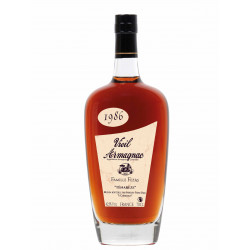
Vintage, for its part, is an old and common practice in Armagnac, according to the same text. Rather than a blend of brandies of different ages, the bottle then holds brandy from a single harvest, with its year on the label.
Blanche, Hors d'Âge, Fine Champagne: Your Cognac and Armagnac Questions
What is Blanche Armagnac?
Blanche Armagnac is a clear Armagnac that is not aged in oak. It rests for at least three months after distillation in a neutral container that gives it no color, and it keeps aromas of fresh fruit or flowers. The term was recognized by a French decree of May 27, 2005.
What is the difference between an XO and an Hors d'Âge Cognac?
For Cognac, XO and Hors d'Âge fall under the same age account in the official specification, account 10, along with Extra. They guarantee the same minimum age, and the producer chooses which term to use. Only XXO and Extra Extra Old require more: at least 14 years.
What does Fine Champagne mean on a Cognac label?
On a Cognac label, Fine Champagne means a blend of brandies from Grande Champagne and Petite Champagne, with at least half from Grande Champagne. It is not a place, and it does not refer to Champagne wine: Grande and Petite Champagne are subzones of the Cognac appellation.
Where can you buy Cognac and Armagnac direct from the producer?
You can buy Cognac and Armagnac direct from the producer on Avenue des Vins. The producer packs and ships your order directly.