Delivery from €16,90 per winemaker in Europe (excluding the United Kingdom)

Les Domaines Pedro
Les Domaines Pedro: Haut-Médoc Château Le Meynieu direct from the estate, a Bordeaux family property...
Lire plus


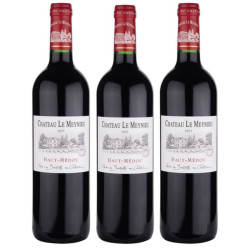
Discover Les Domaines Pedro in photos


Château Le Meynieu: a Haut-Médoc cru by the Pedro family
Château Le Meynieu - Les Domaines Pedro
Château Le Meynieu is a Haut-Médoc cru (AOC Haut-Médoc) located near Saint-Estèphe, in the Médoc. Owned by the Pedro family since 1962, it covers 22 hectares of vines and is part of Les Domaines Pedro.
In the Médoc, just a stone's throw from Saint-Estèphe, a 19th-century house watches over 22 hectares of vines. Since 1962, the Pedro family has been crafting a supple, rounded Haut-Médoc here, both generous and refined, available direct from the winery on Avenue des Vins.
Les Domaines Pedro, a family story
The roots of Château Le Meynieu reach back to the 18th century, long before the house that now gives it its name: the building went up around 1830, just as the Médoc was filling with châteaux. The estate then belonged to the Courrejoles family and produced some forty-five tonneaux; its wines already ranked among the most highly regarded in the Médoc and travelled above all to northern Europe, to Dutch buyers in particular.
By 1874, on the eve of the phylloxera crisis, the property was in the hands of Monsieur Bouquie, then mayor of Vertheuil. Le Meynieu was among the crus bourgeois, and its thirty tonneaux earned medals at the Amsterdam and Le Havre exhibitions. After the replanting that followed phylloxera, the 1908 edition of Féret listed it once again as a cru bourgeois, under the Gué family. Several owners followed, until the harsh frosts of February 1956 damaged the vineyard, as they did across Bordeaux.
It was against this backdrop that in 1962, returning from his scientific studies at the University of Bordeaux, Jacques Pedro took over the property from his parents-in-law. He gradually replanted the Meynieu vines and restored the estate buildings. From 1964, together with his wife, he acquired the fallow parcels of Château Lavillotte and replanted them entirely, then in 1974 had an underground cellar built, topped by a 467 m² air-conditioned barrel hall.
In the 1980s the venture became fully a family affair: his son, Hervé Pedro, took charge of the technical side and his son-in-law, Frank Maroszak, of sales, working alongside Jacques Pedro. The team was strengthened in 2022 with the arrival of a technical director, Sébastien Fraysse. Brought together with Château Lavillotte and Domaine de la Ronceray within Les Domaines Pedro, Le Meynieu has held High Environmental Value level 3 certification since 2021.
The estate's philosophy
To make authentic wines, faithful to the expression of their terroir. Here, time is taken: harvesting at full ripeness, traditional winemaking, ageing in French oak barrels and bottling at the property, for an absolute guarantee of origin.
|
||
|
||
|
||
|
A Médoc terroir, near Saint-Estèphe
Château Le Meynieu enjoys a privileged position near the village of Saint-Estèphe, on a large clay-limestone plateau with a stony subsoil. This type of soil is among the most sought-after terroirs of the Left Bank: it encourages deep rooting of the vine and contributes to both the ripeness and the concentration of the grapes.
The 19th-century house, surrounded by its vineyard, sits within the landscape of great growths that has made the Médoc's reputation.
Château Le Meynieu (Haut-Médoc)
AOC Haut-Médoc - Haut-Médoc cru - Médoc
A clay-limestone plateau with a stony subsoil, near Saint-Estèphe: a characterful terroir for a generous, refined wine with a delicate bouquet.
The vineyard and the grape varieties
Across its 22 hectares, Château Le Meynieu follows the classic Left Bank blend: 60% Cabernet Sauvignon, which brings structure and ageing potential, 35% Merlot, for roundness and fruit, and 5% Cabernet Franc, which adds finesse and aromatic complexity.
With an average vine age of 40 years, the vineyard yields concentrated grapes, harvested at full ripeness thanks to deliberately late picking.
In the cellar: winemaking and barrel ageing
The winemaking remains traditional: a long maceration, frequent pump-overs during fermentation and careful temperature control thanks to a high-performance temperature-regulation system.
After running off, the wine is placed into French oak barrels, one third of which are renewed each year, for twelve months of ageing. It is racked regularly, then bottled without filtration to preserve all of its substance. The underground cellar, maintained at ideal temperature and humidity, gives the bottles optimal conditions for ageing. Bottling at the château guarantees an absolute guarantee of origin.
The estate's wine
The estate produces a red wine for ageing under AOC Haut-Médoc, in the great Médoc tradition.
Château Le Meynieu rouge
AOC Haut-Médoc
In the glass, Château Le Meynieu plays on suppleness and roundness, with a charming character. A blend of Cabernet Sauvignon, Merlot and Cabernet Franc aged twelve months in barrel, this Haut-Médoc is generous, with finesse and a delicate bouquet. It pairs with grilled red meat, duck breast, roast poultry, rack of lamb or a board of mature cheeses.
Château Le Meynieu shares the expertise of Les Domaines Pedro with two other family estates in Saint-Estèphe: Château Lavillotte and Domaine de la Ronceray.
Haut-Médoc cru - direct from the winery, careful delivery
Why choose Château Le Meynieu ?
A Médoc terroir. A clay-limestone plateau with a stony subsoil, near Saint-Estèphe, for Haut-Médoc wines with character and ageing potential.
Traditional craftsmanship. Late harvest, long maceration, ageing in French oak barrels and bottling without filtration, at the château.
An environmental commitment. Les Domaines Pedro have held High Environmental Value level 3 certification since 2021.
A family story. An estate run by the Pedro family since 1962, faithful to the expression of its terroir.
Direct from the winery. On Avenue des Vins, you order without an intermediary, as close as possible to the cellar-door price, with careful delivery across France and Europe.
Frequently asked questions about Château Le Meynieu
Is Château Le Meynieu a good wine ?
Yes, Château Le Meynieu enjoys a long and well-documented reputation. As early as the 19th century its wines ranked among the most highly regarded in the Médoc; the estate was classed as a cru bourgeois in 1874 and listed again in the 1908 Féret, and its wines won medals at the Amsterdam and Le Havre exhibitions. Today this Haut-Médoc charms with its suppleness, roundness and delicate bouquet. Made from a classic blend of Cabernet Sauvignon, Merlot and Cabernet Franc from old vines, it is an approachable, enjoyable Bordeaux, appreciated by French and international wine lovers alike.
Is Château Le Meynieu an organic wine ?
Château Le Meynieu is not certified organic, but it follows a demanding environmental approach. Since 2021, Les Domaines Pedro have held High Environmental Value level 3 (HVE 3) certification, the highest tier of this French state scheme, covering the management of the soil and the vines. HVE 3 assesses biodiversity, the use of inputs and water management. It differs from the organic (AB) label, which focuses on the absence of synthetic products. For any update on possible changes, please contact the estate directly.
What is the difference between Haut-Médoc and Médoc ?
Haut-Médoc and Médoc are two neighbouring regional appellations on the Bordeaux Left Bank. Haut-Médoc covers the southern part of the peninsula, from the outskirts of Bordeaux up to north of Saint-Seurin-de-Cadourne; this is where most of the classified growths are concentrated. The Médoc appellation covers the northern tip of the peninsula, where soils are often more clay-rich. Château Le Meynieu falls within the AOC Haut-Médoc. In practice, Haut-Médoc wines often show slightly more structure and ageing potential, though this varies from one estate to another.
What is the difference between a Haut-Médoc and a Saint-Estèphe ?
Saint-Estèphe is a communal appellation, whereas Haut-Médoc is a broader regional appellation that surrounds it. Both lie on the Left Bank: Château Le Meynieu produces a Haut-Médoc immediately next to the village of Saint-Estèphe, on a clay-limestone plateau. Saint-Estèphe wines are known for their structure and character; a neighbouring Haut-Médoc such as Le Meynieu shares this terroir while offering a more supple, approachable style. The difference lies in the scope of the appellation and in the style, not in intrinsic quality.
What is a Médoc cru bourgeois ?
The cru bourgeois is a Médoc distinction that recognises the quality of estates outside the 1855 classified-growth ranking. It appeared in the 19th century, has evolved over time and is subject to regular selections. Château Le Meynieu historically held this status: it was classed as a cru bourgeois in 1874, under Monsieur Bouquie, then mayor of Vertheuil, and listed again in the 1908 edition of Féret, the reference guide to Bordeaux wines. The wine is today sold under the AOC Haut-Médoc appellation.
How long can Château Le Meynieu be cellared ?
Château Le Meynieu lends itself to several years of cellaring. Its Cabernet Sauvignon backbone, which makes up 60% of the blend, and its twelve months of ageing in French oak barrels give it the structure to evolve in the cellar. Depending on the vintage, it can be enjoyed young, on the fruit, or after a few years once the tannins have softened. Store bottles lying down, away from light, at around 12–14 °C and at stable humidity. The estate has an underground cellar designed precisely for this purpose.
At what temperature should Château Le Meynieu be served ?
Serve Château Le Meynieu at around 16-17 °C, the ideal temperature for a Haut-Médoc. Too warm, the wine seems alcoholic and heavy; too cold, it closes up and its tannins harden. Take the bottle out of the cellar a little ahead of time, or cool it briefly if your room is warm. On a young vintage, a slightly cooler temperature highlights the fruit, while an older wine can take one degree more. A reasonably large glass will help its delicate bouquet open up fully.
Should Château Le Meynieu be decanted ?
Decanting Château Le Meynieu is recommended, especially on younger vintages. Thirty minutes to an hour in a decanter aerates the wine, softens the Cabernet Sauvignon tannins and releases its bouquet. On an older vintage, prefer a short, gentle decant just before serving, so as not to tire an already evolved wine, and to separate it from any sediment if present. If in doubt, taste the wine on opening: if it seems firm or closed, the decanter will help; if it is already expressive, serve it straight away.
What food pairs with Château Le Meynieu ?
Château Le Meynieu pairs ideally with red meats and full-flavoured dishes. Think of a grilled rib steak or rib of beef, a rack or leg of lamb, duck breast, roast poultry or feathered game. Its suppleness also lets it match slow-cooked dishes such as boeuf bourguignon. For cheese, opt for aged pressed cheeses such as Comté, Cantal or Saint-Nectaire. Serve at around 16-17 °C, decanted if you wish. It is a Haut-Médoc that is both food-friendly and approachable, perfectly at ease with traditional, convivial cooking.
What is HVE 3 certification ?
High Environmental Value (HVE) is an official French environmental certification, of which level 3 is the most demanding. It attests to good practices across four pillars: biodiversity, plant-protection strategy, fertilisation management and water management. For a wine estate, it reflects a way of growing vines that is more respectful of natural systems. Les Domaines Pedro, of which Château Le Meynieu is part, have held HVE 3 certification since 2021. This approach is distinct from the organic label: it does not concern the absence of synthetic products, but the overall environmental performance of the estate.
Where can I buy Château Le Meynieu directly ?
You can buy Château Le Meynieu direct from the winery on Avenue des Vins. The marketplace connects you with Les Domaines Pedro without an intermediary, as close as possible to the cellar-door price, with careful delivery across France and throughout Europe. The price varies with the vintage and the format, from bottle to magnum. Buying through this direct channel guarantees the wine's origin and traceability, kept at the property until dispatch, while directly supporting the estate's work. You will find the available vintages on the Château Le Meynieu page.
Haut-Médoc cru, near Saint-Estèphe - direct from the winery
Château Le Meynieu – Les Domaines Pedro, a family of winegrowers in the Médoc, near Saint-Estèphe. A Haut-Médoc cru aged in French oak barrels.
AOC Haut-Médoc - a red wine for cellaring, direct from the winery