Delivery from €16,90 per winemaker in Europe (excluding the United Kingdom)


AOC Quincy
In the northwest of France, the Loire vineyard extends from the Massif Central to Nantes. It is known for the Chinon, Bourgueil and Pouilly-Fumé appellations, among others. The Quincy AOC is also found there. The appellation area of this AOC extends in the Centre-Loire over some 350 hectares of sandy soils mainly composed of gravel and silt. Sauvignon vines, subject to the semi-continental climate of this geographical area, are planted in this appellation and produce white wines. These wines express a bouquet marked by green apple and dried fruits, which develop on notes of white flowers on the palate. Fresh and fine, these wines express rich and varied aromas (blackcurrant, apple, honey, spices, white flowers) to offer a harmonious palate.
Filtrer

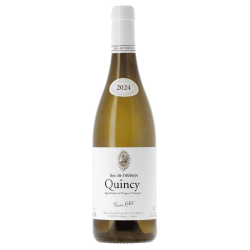
Quincy: Freshness and Finesse in a Semi-Continental Climate
Quincy is a dry white wine made mainly from Sauvignon Blanc in two villages of the Cher department, Quincy and Brinay. The appellation makes still white wine only. The vineyard sits on the edge of a plateau in the Champagne Berrichonne, mostly on the left bank of the Cher River, which laid down its soils and tempers its climate.
A Papal Bull, Cistercian Monks and a Duke of Berry
Quincy appears in a papal bull issued by Pope Callixtus II in 1120. Sauvignon reached the village from the Abbey of Beauvoir, brought by monks of the Cistercian order. Prized by John, Duke of Berry, the wines of Quincy later earned the title of "noble wines."
After phylloxera hit the vineyard hard, growers replanted it and staked their future on white wine. A decree dated August 6, 1936, then made Quincy the first AOC in the Centre-Loire. The appellation now counts about 50 producers, a five-year average according to the Centre-Loire wine council.
An Old Cher River Terrace That Warms Up Fast
The vines grow on an old alluvial terrace of sand and gravel carried down from the Massif Central, resting on lake-formed limestone. These light, free-draining soils warm up quickly in spring. Their low fertility also reins in Sauvignon's vigor, to the benefit of ripe grapes.
Three main soil types stand out: sandy gravel, sand, and sandy silt. Plots sit on gentle hill slopes, between 110 and 133 meters (360 to 435 feet) above sea level, where water drains well and cold air does not linger. These old deposits, sometimes several meters deep, also give the vines a steady, moderate water supply.
The climate is semi-continental with an oceanic influence. The nearby Cher acts as a thermal regulator, helping the vines start early in spring and grow steadily through summer. Sauvignon ripens early here, an asset in late or wet years. The result is dry whites with freshness and finesse.
Citrus, Acacia and a Hint of Mint: Quincy at the Table
On the nose, Quincy often suggests citrus, grapefruit or lemon, then acacia and sometimes boxwood, with a minty, sometimes peppery touch and a mineral tone. On the palate, it stays fresh and fruity.
That freshness calls for shellfish, seafood and grilled fish. For something less expected, pour it with a fresh goat cheese and mint omelet, which echoes its minty notes, or with mushrooms sautéed with pancetta and spices. On the cheese board, a fresh or lightly ripened goat cheese suits it well.
Gauls, a Name and Spring Frost: Getting to Know Quincy
Who was already growing vines at Quincy before the Middle Ages?
At Quincy, vines were likely already grown by the Bituriges Cubi, a Gallic people whose territory included the village. A legend reported by the regional wine council even has them carrying the vine on to the Bordeaux area.
Which Roman may have given Quincy its name?
Quincy's name is thought to come from a man called Quintius, who owned an estate there in Roman times. This origin remains a hypothesis.
What are the frost towers in Quincy's vineyards for?
In Quincy's vineyards, frost towers have been installed to limit the risk of spring frost, which remains significant on this terroir.
Where can you buy Quincy direct from the winemaker?
You can buy Quincy, sold by the producer, on Avenue des Vins. Every wine's page gives the name of its producer.
See also: AOC Reuilly - AOC Sancerre - AOC Coteaux du Giennois